As an Amazon Associate I earn from qualifying purchases. These links may earn this site a commission when you buy, at no extra cost to you.
Answering the common buyer intent: a HEPA-equipped vacuum designed for concrete dust should prioritize strong suction, a true HEPA filter, and easy dust containment for silica-heavy debris. The top picks below are well-suited for construction environments, with recommendations tailored to different users—DIYers, professional trades, and large-job sites. Each product emphasizes HEPA filtration and robust performance, helping you capture fine dust from concrete grinding, cutting, or sawing. A quick summary table highlights which model fits which use case for fast comparison.
| Product | Best For | Why It Stands Out |
|---|---|---|
| DEWALT DWV010 HEPA Dust Extractor | General contractors and pros | Automatic filter cleaning and 150 CFM |
| Bosch VAC090AH | Versatile tool users | Auto filter clean, HEPA filter, OSHA compatibility |
| Makita VC4210L | Heavy-duty cleanup | 12A motor, 148 CFM, automatic cleaner |
| Dustless D1618 | Pro drywall and dust crews | Certified HEPA, 138 CFM, hydrophobic filter |
| ECOMAX 8 Gal 6.5 HP | Workshop environments | HEPA filter, semi-auto clean, big airflow |
DEWALT DWV010 HEPA Dust Extractor
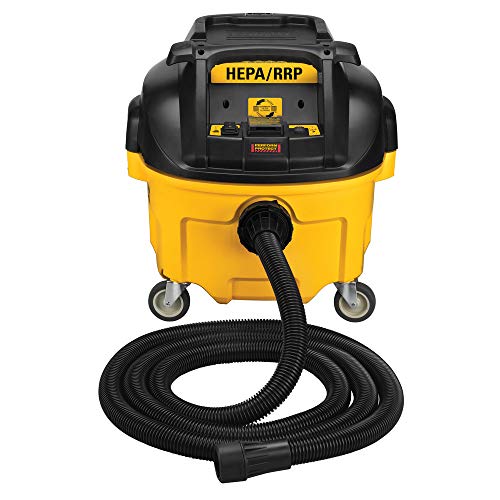
The DEWALT DWV010 uses a true HEPA filtration system with automatic filter cleaning that pulses every 30 seconds. It delivers up to 150 CFM through a compact eight-gallon container, making it suitable for job sites where compact mobility is key. Best for professionals who need continuous operation with minimal downtime for filter maintenance. A potential limitation is that higher airflow models may require more aggressive tool activation to maintain peak performance.
Bosch VAC090AH Portable Dust Extractor

The Bosch VAC090AH combines a portable 9-gallon design with Auto Filter Clean and a HEPA filter. It supports tool-activated start/stop and a Power Broker dial to tailor suction to the task. This model is best for users who value ease of control and OSHA-friendly dust management for silica-heavy work. A consideration is that the unit is heavier than smaller portable vacuums, which can affect mobility on multi-step job sites.
Dapper Supply Wet/Dry HEPA Extractor

The Dapper Supply 8-gallon unit provides a commercial-grade HEPA system with automatic filter cleaning every 25 seconds, delivering up to 140 CFM and 20 kPa suction. It is well-suited for drywall and heavy dust jobs where continuous cleaning without manual filter maintenance is desired. It may be heavier than small-shop vacuums, which could impact portability on stairs or rough terrain.
Dustless Technologies HEPA Wet+Dry Pro Vacuum

The Dustless D1618 features a certified HEPA system that prevents bypass of dust, with 138 CFM performance and a hydrophobic filter to handle both wet and dry debris. Best for projects where silica-control and indoor air quality are priorities. A limitation is that its filter setup may require more routine maintenance to sustain peak performance in very dry, fine dust conditions.
Makita VC4210L 11-Gallon HEPA Vacuum

The Makita VC4210L offers a robust 12-amp motor with 148 CFM and 92 inches of water lift. It pairs an automatic filter cleaning system with a HEPA filter capturing 99.97% of 0.3-micron particles. This model is best for large cleanup jobs where high suction and long runtimes are essential. A potential limitation is the unit’s size, which may be less ideal for tight spaces.
Buying Guide
What to consider when choosing a HEPA vacuum for concrete dust:
- Filtration: Look for a true HEPA filter (H13 or better) to capture fine silica particles and prevent bypass.
- Filtration maintenance: Automatic or semi-automatic filter cleaning reduces downtime during grinding or cutting tasks.
- Airflow and suction: Higher CFM and water lift improve debris capture on large concrete jobs; balance with portability.
- Tool activation compatibility: Vacuum models that activate with your power tools streamline workflow and keep dust containment intact.
- Tank size and mobility: Larger tanks reduce emptying frequency; consider wheeled designs for rough job sites.
- Durability and build: Stainless steel or rugged housings are preferable for workshop and job-site environments.
- Noise and ergonomics: Consider models with lower noise levels and comfortable handles for long cleaning sessions.
Practical Comparisons
- Best for professional contractors: DEWALT DWV010 or Makita VC4210L for strong suction and reliable filter cleaning.
- Better for tool-centered workflows: Bosch VAC090AH with tool-activation options and adjustable suction.
- Choose this if you need wet/dry versatility: Dustless D1618 or Dapper Supply for mixed debris handling.
- Avoid this if you require ultra-compact portability on stairs: Smaller 4-6 gallon units may struggle with large drywall dust loads.
FAQ
- What makes a HEPA vacuum suitable for concrete dust?
A true HEPA filter traps at least 99.97% of 0.3-micron particles, which is essential for silica-containing concrete dust. - Is automatic filter cleaning important for concrete dust jobs?
Yes. It helps maintain suction without frequent manual filter maintenance that can interrupt work. - Should I prioritize higher CFM for concrete work?
Higher CFM improves debris pickup, especially with coarse to fine dust from grinding, but consider hose length and tool compatibility as well. - Can these vacuums handle wet concrete messes?
Some models are dual-purpose (wet/dry) but verify each unit’s wet-dry capabilities and filter type before use on wet spills. - What is the best way to maintain a HEPA vacuum on a job site?
Regularly check seals, clean pre-filters, empty the canister before it overflows, and store in a clean area to avoid moisture damage. - Do these vacuums require special disposal for concrete dust?
Most concrete dust can be disposed of with regular construction waste if local regulations permit; always follow local guidelines for silica-containing debris.