
If you’re tackling mold in a professional or serious DIY setting, you need proven, hospital-grade or professional-grade remediation products that kill, clean, and prevent mold growth. This guide highlights five top options that are commonly used in remediation projects, residences with high humidity, and commercial spaces. Each product is evaluated for who it’s best for, its key strengths, and a straightforward caveat. Use this as a quick reference to choose products that fit your space, equipment, and safety needs.
| Product | Best For | Why It Stands Out | Potential Limitation |
|---|---|---|---|
| Mold Armor Rapid Clean Remediation | Small-to-medium mold jobs at home or office | Fast-acting one-step disinfectant that kills, cleans, and prevents mold and mildew; visible results in 1 minute | Non-abrasive on hard non-porous surfaces; may require multiple applications for stubborn growth |
| Express Chem Myco Mold Control Concentrate | Professional-grade remediation with large surfaces | EPA-registered hospital-grade disinfectant; versatile for mold remediation and surface protection | Requires dilution and proper handling per label; compatible with various application methods |
| Express Chem Myco Mold Control RTU | Ready-to-use applications for quick jobs | Ready-to-use hospital-grade disinfectant; effective mold remediation and prevention | May be less economical for large areas compared with concentrate |
| BlueDri Air Scrubber Stage 2 HEPA Filter | Air quality control during remediation | High-efficiency particulate air filtration (HEPA 99.97% at 0.3 microns); improves indoor air during cleanup | Requires appropriate setup and maintenance; not a disinfectant on surfaces |
| anlab Mold Test Kit for Home | DIY mold detection and IAQ assessment | Six separate tests with individually sealed plates; user-friendly for non-professionals | Provides identification guides but not a substitute for professional lab analysis |
Readers should consider the scale of the project, whether ready-to-use or concentrate formats are preferred, and the need for air filtration or testing. The products below are organized to help you assess best-fit options for your remediation plan, from surface treatment to air quality management and initial mold detection.
Mold Armor Rapid Clean Remediation
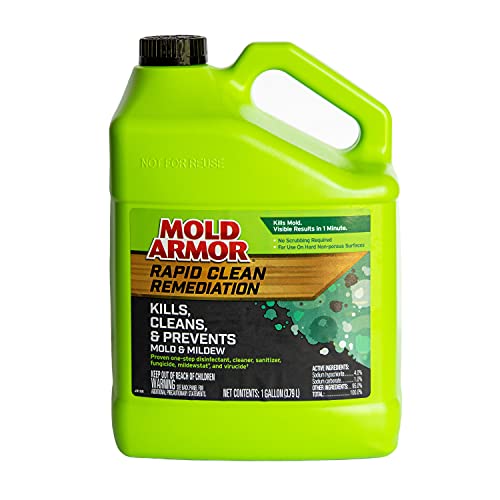
Mold Armor Rapid Clean Remediation is designed to kill, clean, and prevent mold and mildew with rapid visible results. It functions as a one-step house disinfectant, sanitizer, fungicide, and virucide, with a non-abrasive formula suitable for hard non-porous surfaces. Best for small to medium mold issues where quick sanitization is needed and where surfaces can tolerate a fast, wipe-on application. A key limitation is that porous materials may require deeper remediation or repetition to reduce underlying moisture-driven growth.
Express Chem Myco Mold Control Concentrate

This concentrate is a hospital-grade disinfectant designed for mold remediation and bacteria control. It’s suitable for professionals tackling larger or more severe growth areas and supports mold prevention on treated surfaces. It is versatile for application via spray, fogging, or other cleaning equipment, which makes it a strong choice for contractors who need flexible deployment. The product requires careful dilution and adherence to safety guidelines. Choose this if you need a scalable, hospital-grade solution that works across multiple environments.
Express Chem Myco Mold Control RTU

The Ready-to-Use (RTU) version is designed for quick-response remediation tasks in homes or small commercial spaces. It provides hospital-grade disinfection and mold control without the need for mixing, making it convenient for on-the-spot treatment. It’s best for smaller projects or for touch-ups after larger remediation work. A limitation is that RTU products can be more costly per square foot compared with concentrated formulations when used on large areas.
BlueDri Air Scrubber Stage 2 HEPA Filter

The BlueDri Stage 2 HEPA filter is designed to enhance air quality during mold remediation by improving filtration efficiency. It helps capture fine particles, including mold spores, during cleanup and is suitable for professional remediation workflows that involve air scrubbing or negative-pressure setups. It is not a surface disinfectant; use in conjunction with surface treatments to control indoor air quality. Best for projects prioritizing air cleanliness and faster clearance of airborne contaminants.
anlab Mold Test Kit for Home

The anlab mold test kit is designed for do-it-yourself mold detection and indoor air quality testing. It includes six separate tests with individually sealed plates and a detailed identification guide. This kit is useful for initial assessment and for tracking mold presence before and after remediation. It is not a substitute for professional laboratory analysis or ongoing remediation services, but it helps guide decisions about where to focus mold-control efforts.
Buying Guide: Key Purchase Considerations
- Project scope: For large remediation projects, a concentrated product used with appropriate dilution control and compatible with fogging equipment is often more economical and scalable than RTU formats.
- Application method: Consider whether you need spraying, fogging, or wipe-on application. Spray and fog-compatible products offer flexible deployment for walls, ceilings, and hidden areas.
- Surface type: Some products are designed for hard non-porous surfaces; porous materials may require cleaning, drying, and sometimes removal of affected materials.
- Air quality considerations: Pair surface disinfectants with an air filtration strategy (such as HEPA filtration) to reduce airborne spores during remediation.
- Detection and assessment: Use an independent mold test kit to establish a baseline and verify remediation effectiveness over time.
- Safety and handling: Follow label directions for PPE, ventilation, and contact time. Disinfectants can be corrosive or irritants if misused.
FAQ: Quick Answers for Buyers
- What is the difference between RTU and concentrate formulas?
RTU is ready to use with no mixing, ideal for quick jobs. Concentrates require dilution and equipment but are more economical for larger areas. - Can these products be used on porous materials?
Many products are intended for hard, non-porous surfaces. Porous materials may require additional steps such as removal, sealing, or different formulations. - Should I use an air scrubber during mold remediation?
Yes, using a HEPA-rated air scrubber helps remove airborne spores and improves indoor air quality during cleanup. - Is a mold test kit enough to verify remediation?
A DIY test kit can indicate mold presence trends, but professional testing may be needed for definitive verification in some cases. - What safety precautions are essential?
Use appropriate PPE, ensure proper ventilation, and follow all label directions for contact times and surface compatibility. - Which product is best for homeowners vs. professionals?
Homeowners may prefer RTU products and DIY test kits for small areas; professionals typically rely on concentrates and EPA-registered disinfectants with fogging or spraying capabilities for larger remediation jobs.