
Answering your search for a reliable ultrasonic cleaning machine, this guide highlights top models suited for home and small-shop use. These devices excel at removing grime from jewelry, glasses, dentures, watches, and small hardware. Best for hobbyists and light professionals who want fast, chemical-free cleaning with simple controls. The top picks below emphasize ease of use, durable construction, and effective cleaning power. Use the comparison table to narrow your choice before reading detailed product sections.
| Product | Best For | Key Benefit |
|---|---|---|
| Home jewelry cleaning and small items | Digital control with heater and timer | |
| Medium-sized projects, tools, eyewear | Large tank, multiple transducers | |
| Professional-grade cleaning | High capacity with robust power | |
| Small delicate items | Dual cleaning modes, 48 kHz | |
| Compact, versatile use | Dual transducers, preset timings |
CREWORKS Professional Jewelry Cleaning Machine

The CREWORKS 2L ultrasonic cleaner offers 60W cleaning power with a 100W heater and a digital control panel. It’s designed to tackle rust, tarnish, and grime in intricate or hard-to-reach areas. Best for hobby jewelry cleaning, small dentures, glasses, retainers, utensils, and toys. The unit heats to 68–176 F and runs up to 30 minutes with the push of a button. It emphasizes easy operation and quick results, making it ideal for users seeking a compact, user-friendly solution.
Who it’s best for: homeowners and DIY enthusiasts cleaning small jewelry, glasses, and dental items at home. Why selected: compact 2L capacity paired with a straightforward digital interface and built-in heater enables efficient, at-home cleaning without separate equipment.
Caution: The 2L size limits larger items or heavy-duty cleaning. For bulk parts or larger jewelry, consider a bigger model.
VEVOR 15L Ultrasonic Cleaner

This 15L model uses 40kHz frequency with a strong 360W ultrasonic power and 400W heating, designed for thorough cleaning of jewelry, coins, tools, and small parts. Six transducers arranged in a sandwich piezoelectric structure boost cleaning efficiency. A stainless steel 304 tank and basket help keep items in place during cycles up to 30 minutes. Best for: hobbyists or small workshops requiring a larger-capacity cleaner without overkill. Limitation: larger footprint than compact units.
Why chosen: high cleaning power and a generous capacity balance performance and practicality for mid-size cleaning jobs.
VEVOR Ultrasonic Professional Cleaner, 30 L

A 30 L ultrasonic cleaner with 40kHz frequency, digital timer, and heater focuses on heavy-duty cleaning for glasses, watches, rings, and small parts. Ten advanced transducers (sandwich-type) provide robust cleaning performance, while a SUS304 stainless steel tank ensures durability. Maximum workpiece size is substantial, making it suitable for more substantial items or batch cleaning. Best for: small studios or workshops needing professional-level cleaning capability. Caution: higher power requires careful handling to avoid splashing or overfilling.
BYASKZIV Ultrasonic Jewelry Cleaner

BYASKZIV offers 48kHz cleaning with a 304 stainless steel tank and two cleaning modes. It cleans jewelry, eyeglasses, rings, watch straps, and dentures without harsh chemicals when used with water (agent improves results). Five-minute quick cycles or seven-minute deeper cycles let users tailor cleaning time. Best for: budget-conscious users needing dependable daily cleaning. Limitation: smaller tank size may not fit larger items in one cycle.
VisiClean Ultrasonic Cleaner
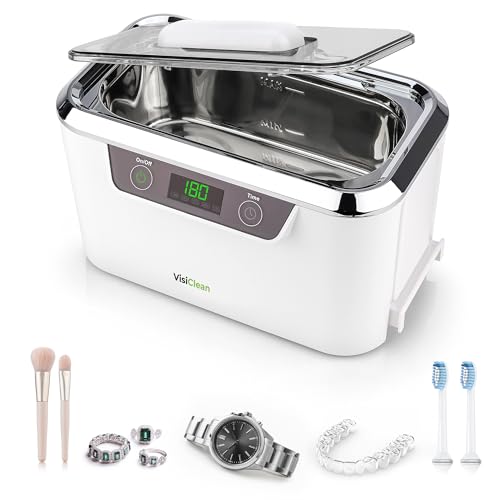
VisiClean provides an 800ml/27oz stainless steel tank with dual transducers and a 42,000 Hz frequency for non-abrasive cleaning. It includes a built-in cooling fan and touch controls with a digital countdown for presets (90-180-300-480-600 seconds). Best for: compact, versatile cleaning of jewelry, glasses, dentures, and small tools. Limitation: smaller capacity may require multiple cycles for larger items.
Buying Guide
What size capacity should you choose? For compact items like rings and glasses, 2–5L units are usually enough. For small repairs or hobbyist workshops, 10–15L offers better room for multiple items. For professional use or larger pieces, 30L units provide ample space and higher cleaning power.
Which frequency matters? Lower frequencies (around 40kHz) deliver stronger cleaning for tougher grime; higher frequencies are gentler and better for delicate items. Two-transducer or multiple-transducer designs generally increase cleaning efficiency and speed.
Is a heater important? A built-in heater helps maintain cleaning temperature, improving grime dissolution, especially for oily residues. If you mostly clean dry items or prefer chemical additives, a heater is less critical.
What about tank material? Stainless steel (SUS304) tanks resist corrosion and last longer, especially with frequent use or salt-containing cleaning solutions. Ensure a sturdy basket and skid-proof base for stability during operation.
Ease of use matters. Digital timers, preset programs, and simple control panels reduce setup time and minimize operator error. Look for units with clear displays and automatic shutoff features after cycles end.
FAQ
- What cleaning tasks can ultrasonic cleaners handle?
– They clean jewelry, glasses, dentures, watches, coins, and small parts with water or minimal cleaning agents. - Do ultrasonic cleaners damage delicate items?
– When used with appropriate settings and cycles, they are non-abrasive, but avoid handling extremely fragile pieces or items with delicate coatings without testing first. - Is a heater necessary for every cleaning job?
– Not always. Heaters improve grease dissolution and speed, but some tasks can be completed with room-temperature cleaning or water-only cycles. - What maintenance do these units require?
– Regularly fill with clean water, change the water after use, and inspect baskets and lids for wear. Wipe the interior to remove mineral buildup if present.