
Disclosure: As an Amazon Associate I earn from qualifying purchases.
A wall mounted touchless soap dispenser can free a crowded sink ledge and make dispensing more convenient. The worthwhile upgrade, however, is a setup that your household or staff can refill, clean and keep powered. A quick sensor is of little help if the chosen soap will not flow or the tank cannot be opened in its installed position.
The five original linked selections below have confirmed wall-mount and automatic dispensing features. This is a comparison of their product information, not a hands-on test of sensor speed, adhesive strength or battery endurance. All five remain relevant, although their power arrangements, capacities and refill requirements differ. The guide starts with those differences, then walks through installation and upkeep.
First decide what goes inside
Liquid, gel and foaming dispensers are different categories. A bottle sold as foaming hand soap should not automatically be treated as suitable for a liquid pump. Likewise, a listing mentioning lotion does not establish that every thick cream will pass through its mechanism. Check the dispenser instructions alongside the label of the product you actually plan to use.
PLUSSEN and the EnBath 40 oz selection expressly exclude foam. SVAVO warns against overly thick contents. RYTOXILO lists several liquid products, but the exact approved viscosity and care directions still need checking. With the EnBath two-pack, verify the current instructions for each intended liquid rather than borrowing specifications from its larger sibling.
A dispenser that accepts a sanitizer does not validate the sanitizer itself, and touchless operation does not make a clinical infection-prevention claim true. The practical benefit discussed here is dispensing without pressing a shared pump. Appropriate contents, correct handwashing and maintenance remain separate responsibilities.
Which original dispenser suits your setup?
SVAVO 600 ml: replaceable batteries and a straightforward reservoir
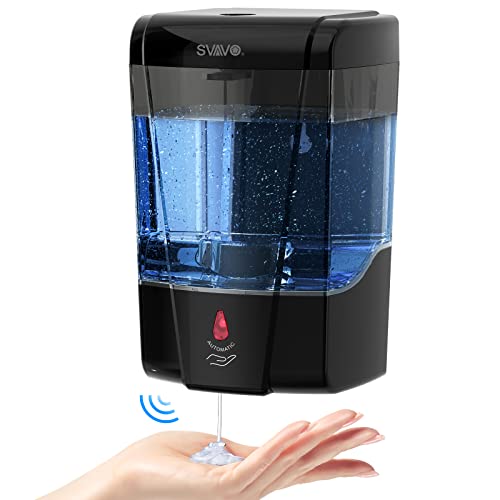
The linked SVAVO selection is Black, 600 ml, with a plastic body and infrared automatic dispensing. It uses four AA batteries, which are not included. The description gives approximately 1 ml per activation and markets a valve intended to cut off flow after dispensing. Those are listed design details rather than measured performance results in this guide.
Replaceable batteries can suit a position where taking a dispenser down for charging would be inconvenient. Keep access to the battery compartment in mind when choosing its location. The seller’s extended-runtime claim should not be used as a guaranteed replacement schedule, since use frequency, batteries and operating conditions will vary.
The maker lists several liquid uses but says the contents must not be too thick. Before filling the whole 600 ml tank, confirm compatibility with your chosen soap and follow the initial setup directions. Do not assume foam compatibility or add water simply because a pump struggles. A nozzle that looks clean from outside may still need the specified internal care.
Useful when: you want a conventional battery-powered wall dispenser and a moderate reservoir. Check before ordering: the mounting hardware, battery-access direction and soap specification. The reviewed information does not establish that adhesive mounting is supplied, so do not plan a no-drill installation without confirmation.
PLUSSEN 600 ml: a visible soap chamber with keyed access

View PLUSSEN White 600 ml on Amazon
The original PLUSSEN option is White-600ml, with an ABS plastic housing, infrared sensor, visible chamber and a locking design supplied with a key. Its stated dose is approximately 0.8 to 1 ml per activation. It is described for liquid contents and explicitly excludes foaming soap.
The visible chamber can make a quick level check easier, particularly where several people use the same sink. The key is a maintenance item: decide who keeps it and where a spare can be stored. Locked access may discourage casual interference, but it is not a promise of vandal resistance or a substitute for supervising unsuitable contents.
The listing describes wall mounting, but do not infer every installation detail from that phrase. Confirm whether the package includes screws, anchors or a bracket appropriate for your wall. The reviewed specifications also contain dimensions that need clarification before a tight-space installation. Obtain a reliable diagram rather than relying on an ambiguous number or photograph.
Useful when: level visibility and controlled refill access matter more than adjustable dosing. Check before ordering: the exact power requirement, mounting method and clearance to open the chamber. No universal promise of zero leaking or guaranteed hygiene improvement is made here.
RYTOXILO 500 ml: rechargeable power and adjustable output

View RYTOXILO 500 ml on Amazon
The original RYTOXILO link identifies a black 500 ml automatic dispenser. The description lists nine output modes, a 1200 mAh rechargeable battery, USB-C charging and an adhesive wall-mount arrangement. It can also be used on a countertop. The selected product was unavailable during the check; that affects purchase planning without changing its relevance to the comparison.
Adjustable output is useful if a fixed dose repeatedly proves too much or too little for the intended soap. Start from the instructions and evaluate an actual dispensing cycle. A higher setting is not automatically more hygienic, and a lower setting is not automatically sufficient for every user or liquid.
The seller describes IPX5 protection and a sealed charging port. That should not be interpreted as permission to immerse the unit, wash it under any pressure or charge it while wet. Confirm care and charging conditions in the supplied manual. The claimed number of days between charges is not an independently verified runtime.
Useful when: you prefer charging to buying replacement batteries and want output adjustment. Check before ordering: adhesive suitability, charging access, current stock and the approved contents. A sticker mounting system still requires a suitable surface and the specified preparation and curing time.
EnBath 40 oz: a larger single reservoir and two mounting routes

This original EnBath link selects Black, 1-Pack, 40 oz. The ABS dispenser accepts liquid or gel soap or sanitizer, excludes foam, and offers either an adhesive bracket or screws and anchors. It has a visible tank and viewing window, with the option to lock access or leave it unlocked.
Power is supplied by four AA batteries or a compatible 6V/1A DC adapter; neither power source is included according to the reviewed description. If using an adapter, verify the connector and the manufacturer’s complete electrical requirements. Keep any cable arrangement appropriate for the installation, especially around water.
The larger reservoir may reduce refill visits compared with a smaller reservoir under otherwise similar use. It does not guarantee a specific service interval or a stated number of dispenses, because dose and usage affect both. The seller’s cost-saving and compliance language is not treated as an independently verified result here.
Useful when: a single sink sees enough use to justify a larger tank. Check before ordering: wall space, lid-opening clearance, mounting suitability and your preferred power source. A larger container that is difficult to service can be less convenient than a smaller one maintained consistently.
EnBath two-pack: two separate 600 ml stations

View EnBath two-pack on Amazon
The original two-pack contains two black automatic dispensers, each listed as 20 oz / 600 ml. Each uses infrared sensing, a visible container, optional locking access and four AA batteries that are not included. The combined package is useful for two locations; it is not one dispenser with a combined large reservoir.
Keep the refill and battery routine separate for each unit. A kitchen station and a bathroom station can empty at different rates, even when the hardware is identical. If they contain different products, label them clearly and avoid transferring leftovers from one chamber to the other.
Do not assume the two-pack includes the larger model’s adapter option or mounting accessories simply because both are EnBath. Confirm the exact package contents and instructions associated with this original selection. Similar photographs and family names can conceal differences that matter during installation.
Useful when: you have two planned wall locations and want a coordinated pair. Check before ordering: the total battery requirement, wall hardware and whether both units will be used. Compare the package cost per required station rather than treating an unused second dispenser as an automatic saving.
Buying guide: plan the location before choosing the tank
Measure the service space
Measure the wall area and nearby fixtures, then allow space below the nozzle for hands and space above or in front for opening the tank. A dispenser can fit on the wall yet be difficult to refill beneath a shelf. Check the removal path too, especially if the battery compartment or charging port is accessed from behind.
Think about the user approaching the sink. A position that is convenient for an adult standing directly in front may be awkward for someone seated or reaching from the side. Use a practical reach check for the intended users. For a regulated commercial installation, verify the applicable installation requirements separately; a product title alone cannot establish that your finished setup complies.
Keep unintended sensor triggers in mind
The sensor needs a clear operating area. A towel, moving object or poorly chosen position may interfere with use or create unwanted activations. Follow the manufacturer’s placement instructions and test the installed location before leaving the tank unattended. A small change in position can matter more than a headline activation-speed figure.
Consider where any released soap would land. Dispensing over a suitable sink area can make cleanup easier, but the nozzle still needs usable clearance. Avoid mounting so low that the user’s hand hits the basin or so far from the sink that normal use leaves a trail across the counter.
Adhesive or screws?
Adhesive mounting is attractive for an eligible smooth surface, but it is not a universal solution for painted walls, uneven tile, textured finishes or damp surfaces. Check the specific adhesive instructions, maximum load and removal guidance. The installed load includes the liquid as well as the dispenser, which is why an empty-unit demonstration is not enough.
Screws and anchors need a suitable substrate and careful planning around concealed services. Use hardware and a method appropriate to the actual wall. If installation is outside your experience, arrange competent help. Neither an included anchor nor a strong marketing claim removes the need to check the surface.
Choose capacity around the maintenance routine
Start by estimating how frequently the sink is used and who will check the dispenser. A large tank can be useful in a shared bathroom, while a lightly used guest bathroom may benefit more from easy cleaning and access. Filling every reservoir to maximum capacity is not a necessary goal.
You can compare nominal capacity with a listed dose to get a rough planning figure, but that calculation is not a guaranteed number of successful uses. Priming, changing settings, leftover liquid and accidental repeat triggers all affect the result. Keep an actual refill log during early use if servicing frequency matters.
For two stations, assign separate checks rather than waiting for both to run low. Make the level window part of a normal cleaning round. A named person, accessible refill bottle and available key are often more useful than a larger tank with no clear maintenance plan.
Power and running costs
With AA-powered units, budget for the required number of batteries and follow the specified battery type. Keep replacements accessible and inspect the compartment during normal servicing. Avoid treating a seller’s months-long runtime estimate as a calendar instruction; the first sign of weak output may require an earlier check.
With rechargeable units, make charging part of the routine and confirm whether the dispenser remains usable while charging. Do not assume it does. Access to the port, time off the wall and the suitability of the charging location affect convenience just as much as nominal battery capacity.
Compare the full setup cost: dispenser, correct mount, batteries or approved power supply, compatible liquid and any replacement parts you may need. A low purchase price can be less attractive if a damaged bracket or nozzle has no replacement route. Confirm support and current return terms before buying several units.
Refilling and cleaning without creating a bigger problem
CDC guidance for healthcare hand hygiene identifies contamination concerns with topping off liquid-soap dispensers. For a refillable unit, follow its cleaning and refill instructions rather than repeatedly pouring fresh soap into old residue. This healthcare guidance is cited for that maintenance concern, not as an endorsement of the products in this guide.
Keep the refill container’s opening and the dispenser chamber clean during servicing. Use the specified cleaning method and allow parts to dry where directed. Do not mix different products in the reservoir or improvise a disinfectant mixture. The housing, seals and pump may need different care from the surrounding sink.
If dispensing becomes inconsistent, check power, liquid level, compatibility and the instructed priming procedure before assuming the sensor has failed. Wipe the sensor area as directed and inspect the nozzle for residue. Stop using a leaking or damaged unit until the cause is resolved; wiping the counter repeatedly is not a repair.
A short installation and first-use checklist
- Match the selection: confirm color, capacity, pack quantity and the power arrangement on the received unit.
- Read before mounting: identify surface preparation, curing time, charging rules and approved liquids.
- Check access: try opening, removing and servicing the dispenser before committing to a tight position.
- Test a normal cycle: follow priming instructions and check dose, hand clearance and unintended activation.
- Assign upkeep: record the liquid used, keep any key available and plan level and power checks.
Check the setup during its first week
After installation, observe a few normal uses rather than judging the dispenser only from its first activation. Check whether people find the sensor area naturally, whether soap lands where intended and whether the selected dose causes repeated waves. If one user consistently needs a second dose, investigate the contents and setting instead of assuming a larger tank will solve the issue.
Also look at the mount and the service routine. Confirm that an adhesive bracket remains secure under its normal filled load and that the tank can be opened without pulling on the housing. Keep a brief note of the date filled, contents and power source. Those details help distinguish an unusually fast emptying tank from a sensor that is activating unintentionally.
For a shared workplace, give users a clear way to report an empty or malfunctioning unit. A dispenser that looks modern but remains empty between maintenance rounds provides little practical improvement. Review the schedule after actual use rather than relying on an advertised capacity alone.
Common questions
Is the fastest sensor always the better choice?
No. Placement, dependable dispensing, suitable dose and easy maintenance matter more than a small advertised speed difference. The quoted activation figures here are manufacturer descriptions, not comparative tests. Choose the feature combination that makes everyday use straightforward.
Can a liquid dispenser make foam?
Do not assume it can. Foam output generally requires an appropriate dispenser mechanism and compatible contents. Follow the selected unit’s instructions. In this group, explicit no-foam limitations should be respected rather than solved with an improvised dilution recipe.
Should every office choose the largest tank?
A larger reservoir makes sense only when usage and servicing access justify it. Two smaller dispensers in the right places can solve a different need from one larger unit. Choose around the locations you actually have, the contents you need and the maintenance you can sustain.