Choose the pad for the task that remains
The floor has visible crumbs near the counter and a separate mark where a drink was spilled earlier. Choosing one mop pad for the whole scene can conceal two questions: how to remove the loose material and what permitted process addresses the remaining spot.
Start with the floor’s identity and care instructions, then describe the soil before choosing the tool. A thick pad, a bright color, or a soft-looking fiber does not establish compatibility with either the floor or the cleaner.
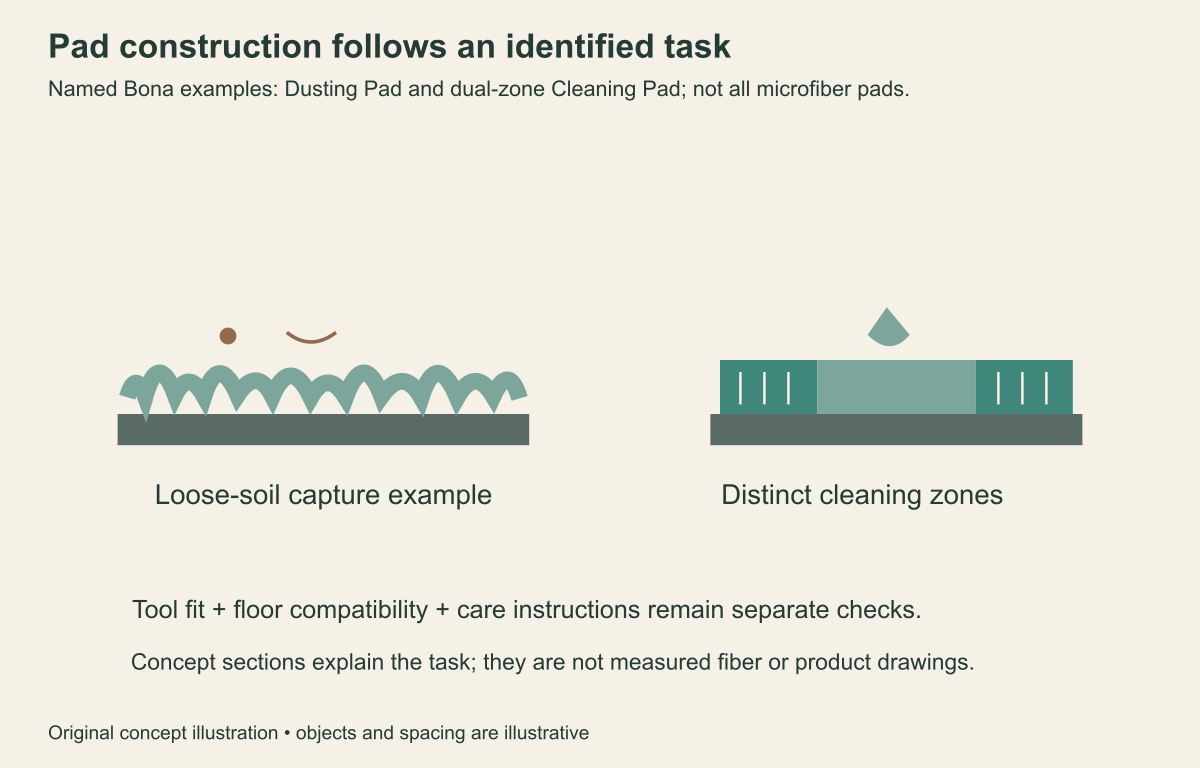
Bona’s current US product pages distinguish its Microfiber Dusting Pad from its Microfiber Cleaning Pad. These specific examples show why the job description matters, without establishing that every fluffy pad is a dust pad or every flat pad belongs in a wet-cleaning process.
Keep the attachment system and the pad’s own care instructions in the decision as well. A pad can look similar to the original while differing in how it fits, what products it permits, or how it should be cared for afterward.
Name the loose-soil task
Bona describes its named Dusting Pad as using electrostatic action to capture dust, hair, and other surface particles. Its page identifies it for the Bona family of mops, making both intended task and equipment fit part of that example.

That description does not diagnose every material found on a household floor. If the debris is unknown, hazardous, or outside the ordinary care task, obtain the relevant guidance rather than trying to collect it with whichever pad is available.
For ordinary loose household soil, choose a method the floor and equipment instructions support. Complete that preparation before assuming a liquid cleaning product needs to handle the same loose material.
Look at the route and where the material has gathered, such as beneath a chair or along the entry. That observation can help you prepare access without turning the task into an unnecessary whole-room chemical treatment.
Check the pad’s condition and previous use before fitting it. A designated dusting pad still needs appropriate care and a usable contact surface rather than being ready simply because its name matches the task.
Identify the separate cleaning task
Bona’s named Cleaning Pad uses darker outer fibers to break up grime and lighter inner fibers to trap and absorb dirt. Its page describes a product-specific dual-zone design, not a guarantee that an unknown blue pad has the same construction.
Determine whether the remaining mark is ordinary soil or a surface condition requiring a different assessment. A dull patch, damaged finish, or unidentified earlier treatment should not automatically become a reason for harder scrubbing.
For a permitted cleaning process, match the actual pad, cleaner, and floor directions. The pad’s material description cannot supply a missing chemical-compatibility decision for the surface.
If a product calls for a particular pad or applicator, identify that requirement before using a substitute. A tool that fits the mop head physically may still lack support for the chosen procedure.
Do not let the pad’s advertised absorption turn into an instruction to add extra liquid. The amount, preparation, and method remain governed by the floor and cleaning-product instructions for the actual task.
Check the attachment with the mop’s identity
Find the mop and replacement pad model information rather than deciding from nominal width alone. Attachment shape, retaining method, and the actual manufacturer compatibility statement need to agree.
Bona’s two named product pages say their pads fit Bona-branded mops, while noting that packaging can vary. That statement belongs to those products and should not be generalized to unrelated mop brands or a replacement pad with a similar outline.
Inspect the pad and attachment before the task, following the equipment’s instructions for fitting it. Do not discover a poorly retained pad halfway across the room and continue while the bare head contacts the surface.
If the original identifying information is missing, compare the equipment with the maker’s current replacement guidance. Provide photographs and model markings when needed rather than guessing from a seller’s broad compatible description.
Keep the confirmed replacement information with the mop’s supplies after purchasing. A note naming the actual pad model makes the next refill decision more reliable than saving only the color or approximate size.
Assess corners and furniture before the first pass
A wide flat head can look convenient in an open floor area while having a different access question near chair legs or a narrow vanity. Identify the actual route and workpiece-like boundaries before choosing a pad merely for its nominal coverage.
At a dining table, sketch the space between the chair legs and the exposed floor outside them. That distinction tells you which portion is accessible with the fitted head and which portion needs preparation or a separate supported method before the task can be completed.
If the head cannot reach an area using a supported method, choose an appropriate separate task or tool. Do not force a pad into a gap while ignoring the floor edge, adjacent finish, or equipment instructions.
Distinguish a loose-soil pass from a spot-cleaning process when planning the route. Both may use the same room, but their supplies and required completion conditions can differ.
Keep clean replacement material available when the selected process requires a change during the work. The appropriate quantity depends on the actual instructions and observed task, not an arbitrary number chosen for a tidy storage picture.
If the pad’s condition changes unexpectedly, stop and reassess before extending the same method into another room. A meaningful observation concerns the actual pad and surface, rather than a general claim that all microfiber performs alike.
Read reusable and disposable care separately
The named Bona Cleaning and Dusting Pad pages describe those specific pads as washable, with claims of up to five hundred washes. That product claim is not a promise of lifetime performance under an unspecified household washing method.
Find the complete care instructions for the pad you own, including any permitted washing products, drying conditions, and replacement criteria. Do not transfer another brand’s temperature or fabric-softener rule simply because both products are called microfiber.
For disposable replacements, follow their intended use and disposal guidance rather than applying reusable-pad laundering assumptions. A physically intact pad has not established permission for another use if its product directions do not support it.
Give used material a clear destination after the task, separate from supplies ready for the next route. That state distinction prevents the next person from treating a folded or neatly stored pad as proof that its care is complete.
Reassess condition after instructed care before returning a reusable pad to the ready supply. Damaged attachment, retained debris, or unreadable identification can create a different decision from simply washing it again.
Keep the result tied to the original job
At the end, check whether the permitted task is complete on the identified surface and whether the tool is ready for its next care step. A pad that looks dirty has collected material, but its appearance alone does not certify the floor’s condition or the procedure’s effectiveness.
If a mark remains, keep its location and the completed method documented for the surface or product maker. Do not let a new pad become the first of several unsupported treatment experiments.
For a household handoff, identify the floor, the fitted pad, the completed task, and the destination of used material. Another person can then continue a defined routine instead of reconstructing it from the mop’s color.
The right choice follows from soil, floor requirements, tool fit, and care instructions together. A distinctive pad design is useful when it supports that exact task, rather than serving as a general promise for every floor mess.
Sources and scope
Sources checked October 14, 2026. This guide uses documented information; it does not claim independent product testing or professional inspection.