Locate the mark before changing the cleaner
The mirror looks clear straight on, but a light from the side reveals broad streaks after wiping. Start by noting where the mark appears and what process was completed, rather than assuming another product will remove a film you have not identified.
An ordinary glass pane, a mirrored surface, and the frame around either one have different care questions. The window cleaner that belongs to an identified pane should not automatically become the treatment for a framed mirror or its neighboring finish.
Pella’s window guidance and KOHLER’s medicine-cabinet guidance provide separate manufacturer examples in this article. They help illustrate the distinction without establishing one universal cleaner or method for every window, mirror, coating, or decorative frame.
This guide concerns reachable ordinary household surfaces with identified care information. An inaccessible exterior pane, damaged fitting, or uncertain installation needs an appropriate access or repair plan rather than stretching the cleaning task beyond its safe scope.
Check the actual surface and nearby materials
Identify the window or mirror product and any stated coating or finish requirements. A clear-looking surface can still have care conditions that are not apparent in its reflection.
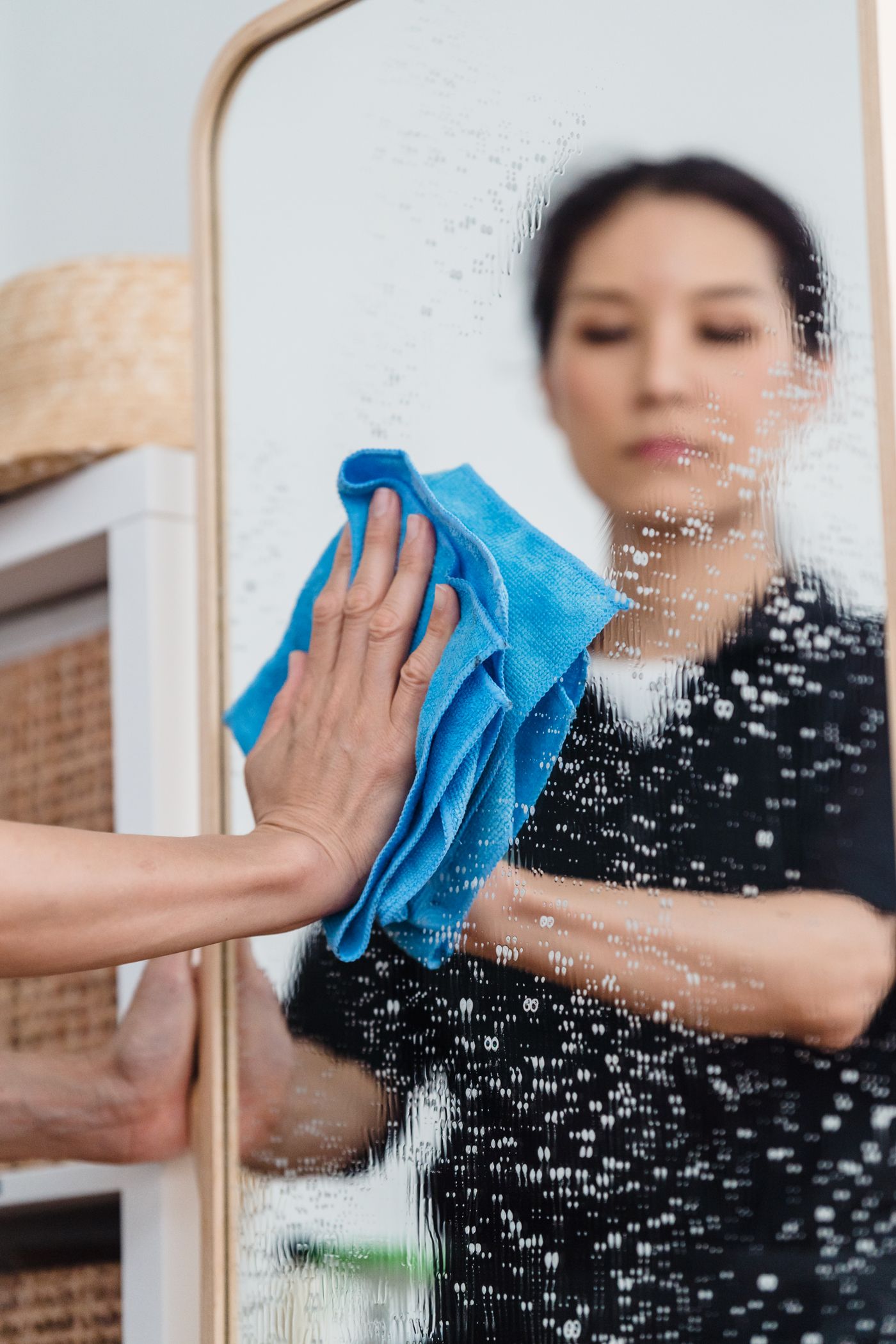
Look at the edges and the adjoining materials before selecting the process. A framed mirror over a painted cabinet may put glass, frame finish, and cabinet surface within a few inches of the same cloth.
Sketch the lower mirror corner and the cabinet edge underneath if the boundary is difficult to follow while working. That small view can show where the intended cloth contact ends and where another material’s instructions must begin, without assuming both parts tolerate the same application.
Find the exact product guidance for the part you intend to clean, leaving another part’s method separate. If the documentation does not resolve an unfamiliar coating or frame, ask the maker rather than trying a stronger cleaner on the whole assembly.
Do not assume a mark you can see is on the accessible face you can wipe. Record how its appearance changes with viewpoint and whether the supported process changes it, then refer a persistent uncertain condition to the relevant manufacturer.
Keep an existing damage concern distinct from ordinary dirt. A changed edge, deteriorated frame, or other material condition should not be scrubbed repeatedly simply because it occupies the same visual area as a streak.
Separate loose material from the finishing pass
Pella’s window guidance describes preparing frames and ledges and using a clean dry microfiber cloth to remove dust from panes. That is a window-specific preparation example, not permission to use every cloth or a household chemical mixture on an unknown mirror.
Inspect the intended cleaning material before using it so retained debris or a prior product is not ignored. A cloth that looks neatly folded may still have a history relevant to the finish in front of you.
Keep the contact tool’s care instructions attached to the task, especially if it was used on another room or surface. An identified clean cloth gives the process a clearer starting point than a shared rag whose contents are unknown.
Avoid adding abrasive contact to chase a stubborn mark when the product guidance does not permit it. The apparent toughness of glass does not answer the question for a coating, frame, or mirrored product.
Prepare a bounded reachable area so you can complete the intended process without handling furniture or supports you have not planned. Ordinary interior cleaning should not quietly become a ladder task or a window-opening procedure copied from another product line.
Read the application location
KOHLER’s medicine-cabinet page instructs users to spray its named Faucet Cleaner onto a soft cloth and wipe the mirrored surface. That is a specific product-and-surface method, which should not be turned into direct-spray permission for every mirror.
The same page calls for a small inconspicuous-area test on unfamiliar surfaces. Follow that guidance within the appropriate product use rather than applying a test to justify an otherwise excluded treatment.
For a different mirror, read the actual maker’s cleaner and application requirements before choosing where liquid goes. A process intended for a window pane may have a different application route from one intended for a framed mirrored cabinet.
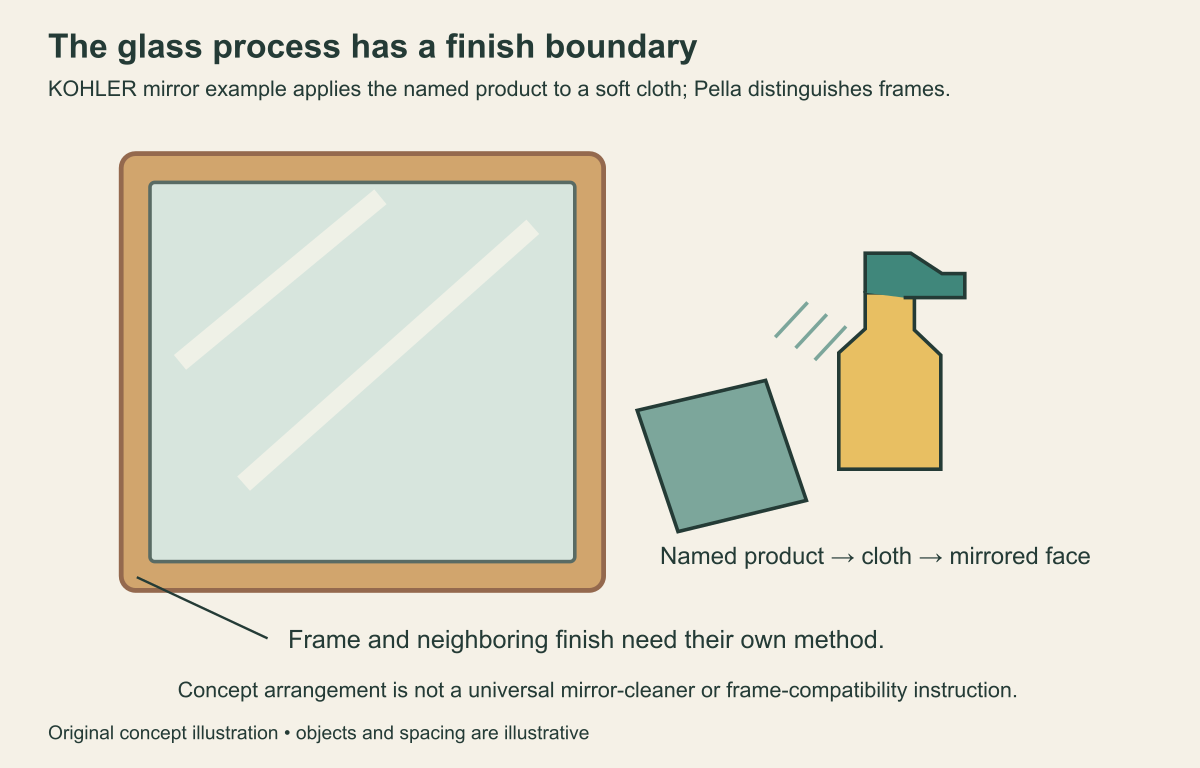
Keep the chosen cleaner and its preparation explicit in the record. A label such as glass spray leaves unanswered whether it is the exact product the surface guidance permits.
Do not add another chemical to make the spray feel more effective. The manufacturer’s supported product and procedure should govern the treatment, especially where adjacent finishes have their own restrictions.
Keep frame care out of the glass assumption
Pella warns that cleaners or solvents used on glass can discolor frames if they contact them. Its separate frame-care instructions illustrate why the glass process cannot automatically continue across the product boundary.
For a framed mirror, make the same boundary visible in your plan while relying on that actual mirror’s guidance. A frame that resembles painted wood or metal still needs its material and finish identified before a cleaner is selected.
Look at the narrow corners and ledges where the cloth moves during the process. Those locations can receive a product even if you intended to clean only the center of the pane.
Do not use a product’s broad glass claim to ignore those neighboring contact areas. A supported application method should address the actual reachable surface and its boundaries, rather than the largest reflective area alone.
If the frame requires a separate task, name it and choose its permitted method independently. The visual convenience of finishing everything in one pass does not supply missing compatibility information.
Compare the completed area in consistent light
Finish the prescribed application and completion steps before assessing the area from the same useful viewpoints. A cloth trail visible midway through treatment may not describe the final result of the instructed method.
Record whether the broad streaks changed, whether a localized mark remains, and whether the surrounding finish responded unexpectedly. These observations describe the result without asserting a chemical cause from appearance alone.
If a mark persists, note the selected product, preparation, cloth condition, and completed method before trying something else. A documented sequence gives the surface maker a clearer question than a list of several cleaners applied without a record.
Do not claim a surface has been restored merely because it looks clearer from one angle. The relevant observation is what changed in the identified area after the supported process was fully completed.
For another attempt recommended by the maker, keep the area and viewing conditions comparable. Changing the light, room, and product at once makes it harder to interpret the difference usefully.
Stop when the question is no longer ordinary film
If the concern appears to involve the product’s edge, installation, or inaccessible part, seek the appropriate assessment. An ordinary cleaning method cannot be assumed to address every visible condition of a window or mirror.
Provide photographs showing both the close concern and its position within the whole product. Include the exact model or identifying information and the care process already completed.
Avoid scraping, opening an unfamiliar assembly, or introducing a solvent outside the guidance to settle the question yourself. The next useful action may be manufacturer advice or qualified service rather than another cleaning pass.
Keep the confirmed cleaner, cloth, and application instructions with the actual product after the task. The next person can then distinguish the mirror, glass pane, and frame without rebuilding the method from a generic household label.
The useful result is an identified surface with a completed supported process and a clear record of any remaining mark. Good observation helps choose the next question, while the actual product guidance chooses the method.
Sources and scope
Sources checked October 14, 2026. This guide uses documented information; it does not claim independent product testing or professional inspection.