The pale mark beside a coffee mug can look like something you should scrub away, especially on a polished countertop. Before trying that, find out what the counter is and separate an ordinary cleaning question from a change to the finish.
A stone-looking pattern does not identify natural stone, engineered quartz or another surface, and a showroom nickname may not provide enough care information. Start with the invoice, supplier or installer instead of choosing a cleaner from the counter’s color.
This guide is a practical way to manage everyday countertop care and describe a stubborn mark clearly. It does not offer a home polishing, stain-removal or sealing recipe for an unidentified surface.
Give the counter an actual identity
Look for the supplier’s product name and any care document that came with the installation. If you find only a photo and a broad term such as marble look, keep that uncertainty visible when you ask for instructions.
Ask the supplier whether the surface is natural stone and which finish or treatment applies to it. A specific answer lets you read the appropriate care information without turning a visual resemblance into a material fact.
Include information about any known sealer, coating or later repair in the request. If a previous owner handled that work, ask for its record rather than assuming the current surface is exactly as originally installed.

The Natural Stone Institute distinguishes acid-sensitive calcareous stone from siliceous stone, while still advising against acidic cleaners for the latter. That distinction is a reason to identify the material, not permission to test an unknown counter with vinegar.
Keep a short care note with the confirmed name, the supplier contact and the permitted routine product. It gives another household member something precise to follow when the next spill happens.
Set up the work area around ordinary use
Look at where cups, food containers and utensils normally sit, rather than treating the counter as one empty rectangle. A small area beside the kettle may be the place you most often need to clear for ordinary wiping.
Move loose objects when it is safe and practical, and check what is underneath before putting them elsewhere. You want access to the actual surface, not a larger cleaning project involving appliances or installed fittings.
The Institute recommends coasters under glasses, particularly drinks containing alcohol or citrus, and trivets or mats for heat protection. Those are simple contact boundaries you can build into your kitchen’s layout without assuming the stone is indestructible.
For example, give the usual drinking spot a coaster and keep a suitable trivet near the place where you set serving dishes. Their useful role is clear placement at known contact points, rather than a promise that every accident will be prevented.
Keep the routine-care cloth and cleaner identifiable so a well-meaning helper does not substitute a bathroom product. The fact that two bottles both say surface cleaner is not enough to establish the same countertop use.
Handle an ordinary known spill as a spill
For a known everyday spill, the Institute’s guidance starts with prompt blotting instead of spreading it by wiping. Its care instructions then describe water and mild soap, rinsing and thorough drying with a soft cloth.
Apply the confirmed surface and product instructions to that ordinary event, including any additional restrictions from your supplier. An unknown chemical spill or a damaged surface is a different question from a small drink spill on an identified counter.
Once the permitted care is complete, look again at the specific place where the liquid sat. You can report that the loose spill is gone while a visible mark remains, rather than calling the entire process unsuccessful.
Keep the drink or food identity in the note if you know it, along with the approximate location. That is useful context for the supplier even though it does not establish the mechanism of the remaining mark.
Avoid recreating the spill as a test on another part of the counter. A second deliberate exposure does not make the original observation more useful for choosing a safe next step.
Keep routine cleaning separate from restoration
The Institute describes neutral cleaner, stone soap or mild liquid dishwashing detergent with warm water for routine cleaning, followed by rinsing and soft-cloth drying. It also warns that excessive cleaner concentration can leave film, so more product is not automatically a better routine.
Use the exact permitted product directions instead of an improvised stronger mixture. The practical question is whether you completed the approved process, not how much foam or fragrance you produced.
Afterward, compare the dry surface under its normal lighting, especially the area that prompted the clean. A mark that is still visible should be described by its location and appearance before you decide that it needs another chemical.
Do not use a change in shine as proof of a removable stain. A dull patch and a darker patch are different observations, and neither can be diagnosed reliably from a single phone photo.
The Institute says acids can etch some finishes and that etched areas may require a stone dealer or professional restorer. That is a different task from removing ordinary soil with the counter’s routine cleaner.
Describe the mark before seeking a treatment
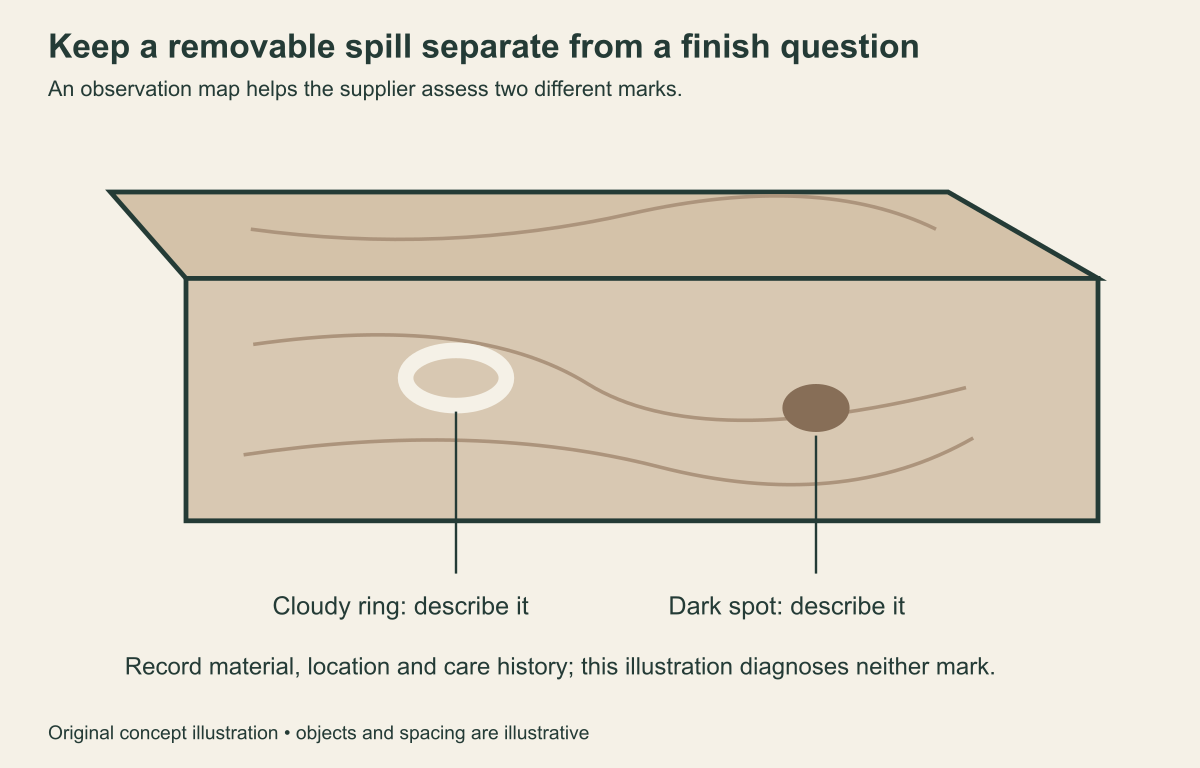
Take an overview that shows the mark’s place on the counter and a closer view from the same ordinary light. Include an everyday reference object nearby if helpful, without placing a new substance on the mark.
Write what you can actually see: a ring beside the coffee machine, a dull patch under the usual glass or a dark area near a plant. Avoid labels such as acid burn, oil stain or failed sealer unless the supplier has established them.
A hypothetical counter might have one cloudy ring and a separate dark spot near a container. Keep those descriptions separate so the person advising you does not assume both changed at the same time or came from the same contact.
Tell them what routine cleaner was used and whether the mark changed afterward. Include any previous attempted treatment you know about, because the next advice needs the actual history rather than an idealized first clean.
Stop at that record when the material or treatment is uncertain. A concise description can move the question toward a suitable professional method without turning your kitchen into a trial of stain-removal recipes.
Do not treat sealer as a universal shield
According to the Institute, an impregnating sealer improves stain resistance rather than making stone stain-proof, and some stones do not need sealing. That means a claim that the counter is sealed does not settle every care or spill question.
Ask the supplier what, if anything, was applied and which care or renewal instructions belong to that product. Do not invent a yearly application schedule simply because another home’s countertop uses one.
If the counter is used for food preparation, ask specifically about the intended use of any proposed treatment. Keep that approval question with the actual product name rather than assuming all stone products have the same role.
Avoid a homemade water-drop experiment as the sole basis for choosing or reapplying a treatment. The installed material, its existing condition and the product instructions need to be understood together.
Give the household a usable care handoff
Make the everyday note short enough to read while clearing the breakfast dishes: confirmed surface, permitted routine cleaner, cloth and supplier contact. Include the location of a persistent mark if someone else should leave it for assessment.
For a guest or cleaner, identify the counter directly instead of saying use the usual stone spray. A photograph of the kitchen beside the confirmed product name prevents that instruction from drifting onto a different bathroom or table surface.
When a mark needs more than routine care, send the supplier the material record and your observation notes before attempting restoration. The useful outcome is a specific next action for that counter, with ordinary cleaning and finish repair kept understandable.
Sources and scope
Sources checked October 14, 2026. This guide uses documented information; it does not claim independent product testing or professional inspection.