Plan the week you actually have
A weekly cleaning plan fails quickly when it assumes an empty house, unlimited energy, and every surface ready to clean. Start with the week’s real constraints: the nights you are home, the rooms people need to use, and the tasks that cannot wait for a long weekend session.
The American Cleaning Institute offers a routine organized into daily, weekly, monthly, seasonal, and yearly tasks. Its list is a useful starting framework, while your surface instructions, household activity, and specific needs determine how the work fits your home.
This guide turns that framework into a small, adjustable weekly plan rather than a health guarantee or a universal cleaning deadline. A spill or a special situation may require a separate response regardless of where it sits on the calendar.
Picture two adults sharing a kitchen, one bathroom, and a living room that becomes a workspace during the day. The plan needs to keep those spaces usable while making the next cleaning task clear enough that either person can start it.
Separate the daily reset from the larger task
ACI’s daily examples include clearing clutter, spot cleaning, and wiping kitchen counters and tables after meals. Those actions belong to the immediate use of the room rather than automatically waiting for a designated kitchen-cleaning day.

For your plan, define the daily reset in terms of visible results: dishes dealt with, the needed food-preparation area clear, and the walking route available. Avoid adding every postponed job until the reset becomes an hour-long project nobody can sustain.
Write down what interfered with the reset last week. If incoming mail covered the table every evening, a place for that mail may solve more of the recurring problem than scheduling additional table-wiping time.
Keep each surface’s permitted care method attached to the task. A quick daily job still needs an appropriate product and tool, especially where different finishes share the same small counter.
The reset is complete when the space is ready for its next normal use, with required cleaning performed appropriately. It does not imply that every appliance, cabinet interior, or upholstered item has been addressed.
Choose a small number of weekly anchors
ACI’s weekly examples include floor cleaning, dusting, bathroom cleaning, changing linens and towels, and clearing the refrigerator. Use those categories to inspect what your home actually needs rather than copying a long checklist without considering room size or use.
Choose one or two anchors that have a clear place in your week. For the shared apartment, floor cleaning might fit the evening when the living-room workspace is packed away, while the bathroom might fit a quieter morning.
Name the room and result more precisely than “clean house.” A task such as cleaning the bathroom sink, counter, and mirror according to their care requirements is easier to prepare for and hand over.
Do not promise that one evening will complete every weekly category before you have observed the actual effort. A plan with honest limits can be revised; an oversized plan tends to conceal which parts were never finished.
Put the anchor where the room is available, not where a sample schedule places it. A busy household may have a useful cleaning window on Tuesday afternoon and no useful window on Saturday morning.
Put preparation before the cleaning window
Imagine scheduling the bedroom floor while the floor is still covered with storage boxes from a move. The first task is to arrange a clear, permitted working area, so the scheduled cleaning tool does not spend its whole window waiting for access.
Separate that preparation from the cleaning itself when necessary. One person can remove ordinary clutter earlier while the other performs the surface-appropriate floor task when the space is ready.
Check that the required tools are usable and the products remain identified before the planned window. A vacuum with a missing attachment or a cloth still awaiting care creates a preparation problem that a calendar reminder cannot fix.
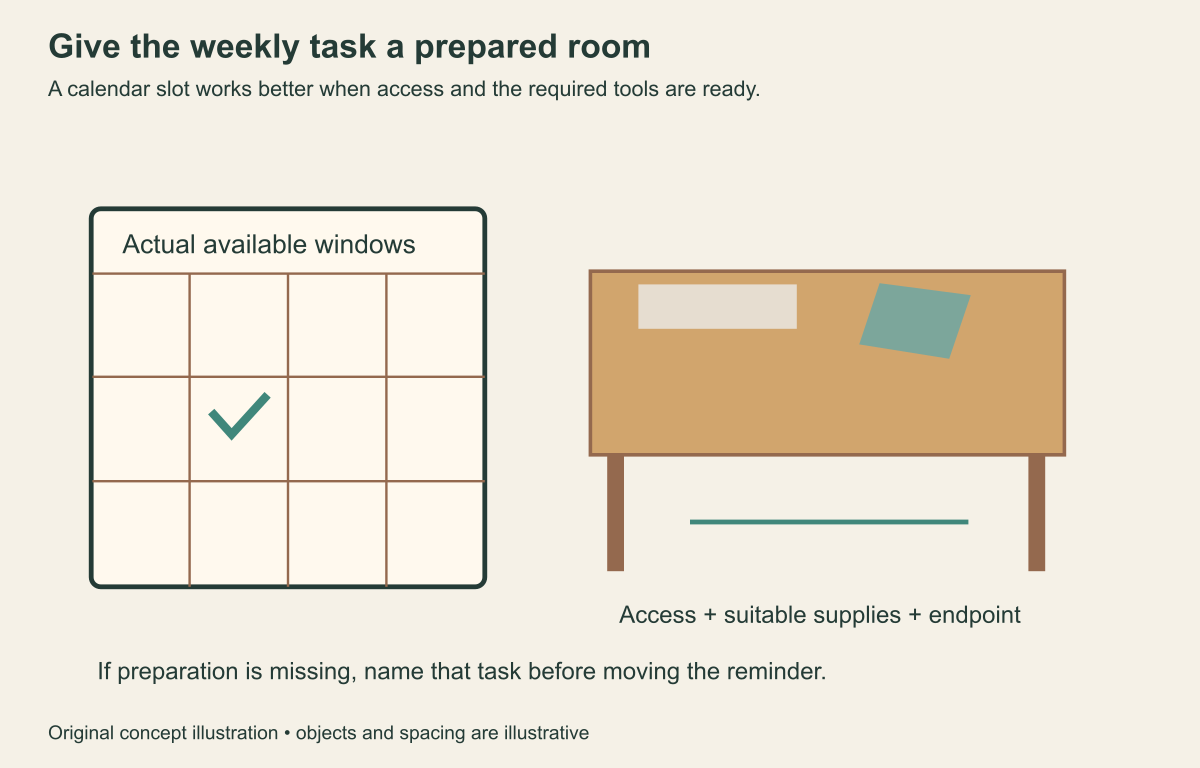
Do not turn preparation into an instruction to move heavy furniture or handle unknown materials without a suitable method. Define the reachable, ordinary work and leave tasks requiring different help or equipment clearly marked.
A short preparation note can prevent the same delay next week. “Move the two lightweight storage bins before the floor task” is more useful than repeatedly writing “start earlier” after the task runs late.
Assign ownership and a visible endpoint
When several people share the work, name who owns the result and what needs to be ready before another person begins. Shared responsibility without a clear handoff can leave both people assuming the other has already dealt with the room.
For the bathroom, one person might prepare the clear countertop and identify the suitable supplies, while another completes the planned cleaning. The handoff should say which tools are clean and whether any surface question remains unresolved.
Describe the endpoint so it can be checked without judging effort. A cleared and appropriately cleaned table ready for breakfast communicates more than a message saying the kitchen was worked on for twenty minutes.
Avoid using the same label for ordinary cleaning and a separately required disinfecting procedure. If the household needs a specific labeled process, put its actual requirements into the plan rather than assuming an ordinary wipe completes it.
If a task cannot be completed, record the concrete reason and the next step. “Counter material not confirmed; ask installer” gives someone an action, while “bathroom unfinished” gives no explanation of what is safe to do next.
Reserve a place for less frequent work
ACI’s broader routine includes monthly and less frequent categories, so those jobs need not silently expand every weekly session. Keep a separate list for appliance interiors, curtains, and other work that requires its own instructions or preparation.
For this week, choose at most one additional job that fits the available time and current need. If the refrigerator shelf has a specific spill, address that identified issue rather than treating the entire appliance as an automatic large cleaning project.
Do not postpone an urgent problem simply because its general category appears on a less frequent list. A schedule organizes routine work; it does not set a waiting period for a spill, equipment fault, or a situation requiring professional help.
Keep maintenance and cleaning distinguishable when planning an appliance. An unfamiliar service procedure, filter replacement, or electrical problem deserves its own manufacturer guidance and appropriate help rather than being absorbed into a wiping task.
When the extra job does not fit, move a defined task to the next suitable window instead of carrying a vague backlog. The note should preserve what remains to be done and what must be ready before it starts.
Review the plan using what happened
At the end of the week, look at the missed or repeated tasks rather than rating whether the household cleaned enough in the abstract. The useful questions concern access, tools, timing, and whether the defined result was clear.
If the floor task took longer because cables and chairs had to be moved, make preparation explicit next time. If the bathroom task stalled on an unknown surface, resolve the surface information before assigning another cleaning window.
Keep a task that worked well in the same practical place unless a real constraint changes. A plan need not become more elaborate each week to be useful.
For a busy week, protect the immediate necessary work and reduce optional additions deliberately. An honest smaller plan gives the household a clearer starting point than an unchanged full checklist that everybody expects to miss.
The weekly plan should leave a usable home and a readable account of what remains. Adjust its timing from observation, keep care requirements attached to actual surfaces, and let completed results decide whether the arrangement is working.
Sources and scope
Sources checked October 14, 2026. This guide uses documented information; it does not claim independent product testing or professional inspection.