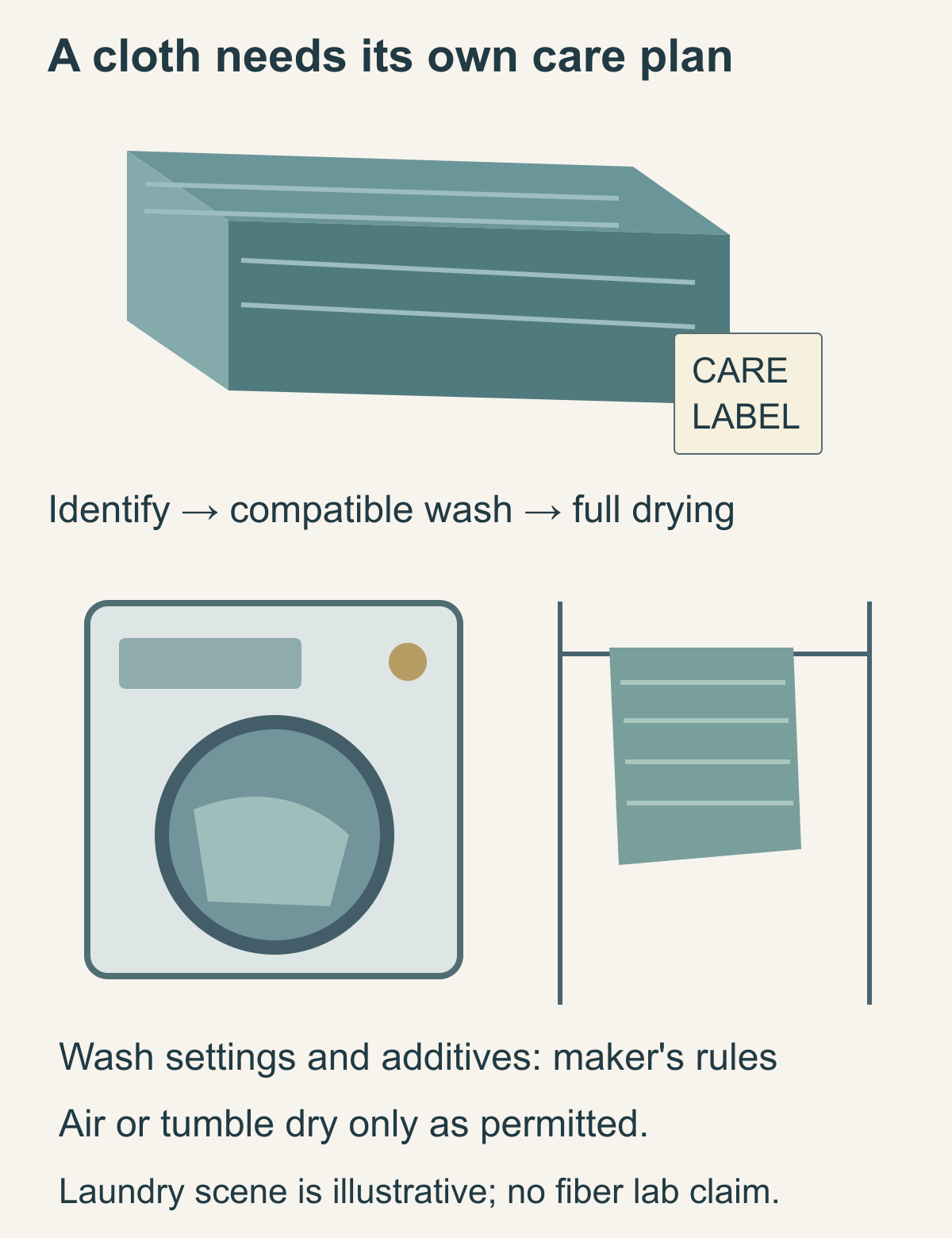
The most useful microfiber washing rule is to identify the cloth before choosing the wash. The label or manufacturer's care page should decide the temperature, detergent restrictions, and drying method for the item you actually own.
You can build a simple routine around those instructions without turning the laundry room into a laboratory. Keep dirty cloths separate from clean ones, remove loose debris, and avoid carrying one brand's care directions onto a different product.
Find out which cloth you have
Look for a sewn tag, package, order record, or recognizable product name. A pile of similar-looking cloths can contain different weaves and intended uses, so color alone is not a reliable way to identify care requirements.
E-Cloth's care page explains that many of its cloth tags name the intended task, while its Glass & Polishing Cloth uses an embossed logo. That is a useful identification clue for those products, not a universal labeling system.
If the cloth came as a mop refill, look up the exact mop system and refill. A flat spray-mop pad and a spin-mop head may share a microfiber description while having different attachments and drying needs.
When you cannot find the product identity, avoid guessing a high-temperature or chemical treatment. Set the item aside until you can establish suitable care, or replace it with something whose instructions you can retain.
Keep washing instructions with the cleaning kit
Save a short note for each cloth type, including the brand, model or product name, and the care-page link. Put a printed version near the laundry basket if several people handle household cleaning.
The note should name the actual settings or restrictions supplied by that maker. "Wash microfiber normally" leaves too much room for someone to assume that a clothing cycle or towel load is automatically appropriate.
If an instruction uses a maximum temperature, treat it as a limit rather than a requirement to choose the hottest available setting. Your washer's controls and the cloth's actual label still need to agree.
Separate a manufacturer's warranty or replacement recommendation from your own schedule. A published guarantee is conditional on its terms, and a season-based suggestion does not mean an undamaged cloth becomes unusable on a particular calendar day.
Remove loose debris before the wash
Inspect the cloth in good light for grit, hair, food particles, or an object caught in the fabric. A cloth used around a gritty entryway deserves that check before you return it to a delicate household surface.
Handle the debris in a way that suits the mess and your cleaning instructions. Do not shake a dusty or contaminated cloth around a room simply to make it look ready for the washer.
For an ordinary cleaning cloth, the maker may recommend rinsing after use. E-Cloth's General Purpose Cloth directions include a daily rinse and wring-out step, which is specific guidance for that product.
Rinsing does not make every cloth ready for every next job. Keep the cloth's previous use in mind and complete whatever washing or treatment is appropriate before moving it to a new area.
Make a small load that you can manage
Group cloths by compatible care directions and household cleaning zone. This makes the next step easier to understand than throwing every cleaning textile into one basket and choosing an average setting.
Keep lint-producing items away when the cloth's instructions call for that separation, and inspect the wash afterward. A cleaning cloth covered in lint may make a glass-cleaning job more frustrating even if it feels freshly laundered.
You do not need a huge stack of cloths to have a workable system. A few clean replacements can let you stop using a dirty cloth without postponing the entire job until the next laundry day.
Leave room in the wash according to the washer's directions. Packing small textiles into a tightly compressed bundle makes it harder to judge whether the load has been handled properly.
Use the maker's detergent and additive limits
For its General Purpose Cloth, E-Cloth specifies a small amount of detergent and says to avoid bleach, fabric softener, and dryer sheets. Its instructions also permit tumble or hang drying for that cloth.
O-Cedar's EasyWring care page gives different product-specific details: a warm, delicate wash for the head, no bleach or fabric softener, and air drying. That difference is why "all microfiber is the same" is not a useful laundry plan.
Do not combine the instructions into a new homemade treatment. A care step approved for one named cloth, such as an extra-hot wash, should not be assumed appropriate for a mop pad from another maker.
Measure detergent using the relevant machine and product guidance rather than pouring extra because the cloth looks dirty. More product is not a reliable substitute for the correct load, setting, and rinse instructions.
Dry the item before putting it away
Check the permitted drying method and choose a place where the cloth can finish drying. A folded pile on a narrow shelf is storage; it is not a substitute for an appropriate drying arrangement.
For a head or pad intended to air dry, expose it as directed instead of sealing it immediately in a bucket or plastic bag. Let the storage location suit the dry item, rather than trying to force a damp item into its final compartment.
Feel and inspect the thicker areas before returning the item to the clean supply. A hem, layered pad, or gathered mop head may be less straightforward to assess than a thin, flat cloth.
Keep the clean supply easy to distinguish from the laundry waiting area. The next cleaning job should not begin with a debate about whether a cloth on the counter has already been washed.
What to do after an accidental softener cycle
Check the exact manufacturer's recovery guidance instead of applying an internet recipe. E-Cloth gives a rewash instruction for accidental fabric-softener or dryer-sheet use on its General Purpose Cloth.
If your own maker gives no recovery method, ask its support team or use a replacement for a demanding surface. Do not assume boiling, solvent soaking, or repeated hot drying is a harmless experiment on every textile.
Write the mistake into the care note if it helps avoid repeating it. For example, keep the cleaning-cloth detergent beside a clear reminder that this load has different additive limits from ordinary clothing.
The important outcome is a usable, correctly cared-for cloth, not proving that every mishap can be reversed. When you cannot establish that outcome, do not conceal the uncertainty by returning the item to a sensitive task.
Decide whether the cloth still suits the job
Inspect seams, attachment points, and the cleaning surface before use. A torn pad that will not stay on its frame is a different problem from an ordinary cosmetic stain that remains after an approved wash.
If the cloth leaves unexpected residue or debris, recheck the care method and the surface's own cleaning instructions. Do not respond by adding a stronger cleaner without identifying what changed.
Replace an item that is damaged, cannot be properly identified, or no longer works for its intended use. Keep its replacement's packaging or care link so the next laundry decision is easier.
Keep the routine simple
Use three recognizable stages: used and awaiting care, drying, and clean and ready. The containers do not have to match, but their purpose should be clear to anyone helping with household chores.
Read the care note when the product changes, then let the established routine handle the ordinary loads. That combination gives you consistency without pretending every microfiber cloth needs an identical temperature, additive, or replacement date.
Sources and scope
Sources checked October 14, 2026. This guide uses documented information; it does not claim independent product testing or professional inspection.