Describe the behavior before naming the fault
The vacuum leaves ordinary crumbs at the doorway even though the motor still sounds familiar. That observation could involve the selected surface setup, the pickup path, or a maintenance problem, so begin with what happened rather than declaring the motor weak.
Record the exact machine, attachment, surface, setting, and when the change began. Include whether the behavior appeared after emptying the container, changing a filter, fitting another head, or moving to a different floor.
If the symptom began immediately after one of those events, write the event and its timing beside the observation. That connection gives the support representative a particular assembly or setup question to investigate, while still leaving open whether another issue explains the change.
This guide explains a safe troubleshooting record using manufacturer examples, not a universal teardown procedure. The actual model’s shutdown, inspection, and user-maintenance instructions govern what you may check.
Do not keep running a machine that has consequential damage, unusual heat, an electrical concern, or behavior its instructions say requires service. An ordinary pickup complaint should not conceal a separate condition that changes whether the machine can be used.
Separate poor pickup from an assumption about suction

Note whether material remains under the floor head, whether an attachment behaves differently, or whether the machine stops or pulses. Those are distinct observations, and a phone description does not measure airflow or establish a specific failed component.
For a rug, include any unusual difficulty moving the head and whether the selected setup matches the care requirements. The surface and head arrangement may need review before a technician can interpret the pickup complaint usefully.
For a narrow-gap tool, record whether it was the confirmed compatible accessory and correctly fitted under the instructions. A poor connection or mismatched attachment creates a different question from an issue that occurs with the usual floor head.
If you have not performed a particular comparison safely under the manual, leave it as an unanswered question. Do not run the machine in unsupported configurations simply to give the service call a more complete-sounding diagnosis.
Keep the room’s actual soil in the account as well. An unfamiliar material or spill may not belong to the machine’s intended dry-cleaning task, regardless of how well it collected ordinary household debris before.
Find the exact troubleshooting guide
Match the machine’s model marking to the manufacturer support information and read the relevant fault section. A guide for another series may name parts, controls, and permitted access points that your machine does not have.
The BISSELL 2252-series table lists several low-pickup possibilities, including height adjustment, a clogged route, tank condition or seating, and dirty filters. Its list is an example of separate checks, not a diagnosis of every vacuum that leaves crumbs.
Use the guide to plan the order of the permitted checks before changing anything. Starting with the identified setup and recently handled components may give you a clearer account than dismantling several unrelated parts at once.
Keep the manual open beside the machine so you can distinguish a named user-maintenance step from a service procedure. A part that can be seen through a cover is not automatically intended for household removal.
If the manufacturer support page does not expose the required instructions, ask for the correct guide rather than filling the gap with another model’s video. Record the access or identification problem honestly so the next step addresses it.
Put the machine in its instructed safe state
The BISSELL example requires turning the power off and unplugging before maintenance or troubleshooting checks. A cordless model may have a different prescribed safe state, so the actual machine’s instructions remain essential.
Do not inspect moving parts while expecting your hand to avoid the switch reliably. Follow the relevant shutdown procedure and prevent unintended operation as the manufacturer directs before beginning an allowed inspection.
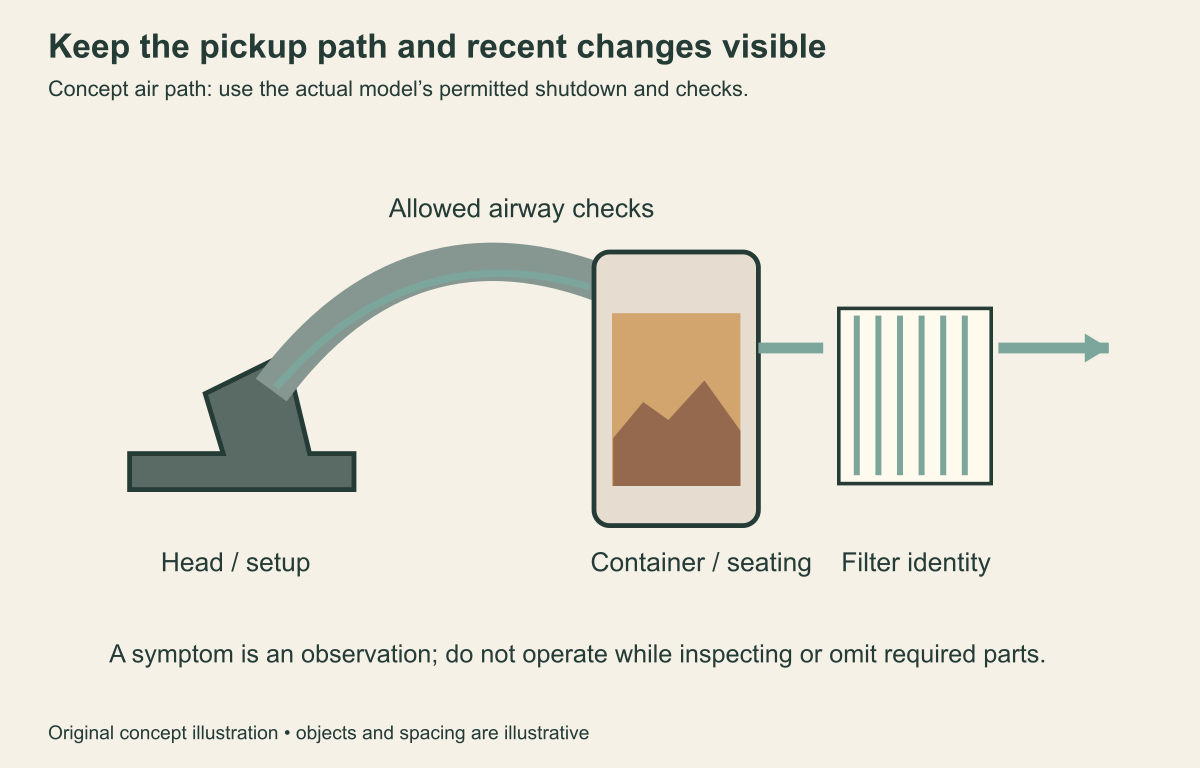
Prepare a clear area with the correct instructions and room for any user-removable components. Keep the parts distinguishable so a recently removed filter is not confused with an unrelated spare from the storage box.
Avoid inserting improvised sharp tools into an airway or opening that the guide does not tell you to access that way. A visible obstruction needs the supported removal method, not a guess based on its apparent distance from the opening.
If an allowed step reveals damage, an inaccessible obstruction, or a condition outside the guide’s scope, stop at that finding. Documenting it gives the service representative a useful endpoint instead of leaving an altered machine whose original state is harder to assess.
Review the container and filter as separate checks
Record whether the dirt container or bag has reached its instructed limit and whether it was recently removed. Follow the actual emptying or replacement procedure and its reassembly requirements rather than treating any visible empty space as proof that the component is correctly fitted.
A filter’s identity and installed state belong to another check. The BISSELL table distinguishes dirty filters from missing or incorrectly installed filters, which is a reason to avoid collapsing all of those conditions into one vague filter problem.
Find the exact care instructions before washing anything that looks like a filter. Some components have prescribed cleaning or replacement procedures, and a filter’s appearance does not establish water-washability.
Keep any required drying or replacement step complete before the machine returns to operation. Do not temporarily omit a required filter to see whether pickup improves under an unsupported arrangement.
Record what was changed and what remained unchanged after each permitted step. That account helps distinguish a reseated container from a replaced filter when the observed behavior improves or persists.
Treat pulsing and stopping according to the model
A pulse or stopping pattern is an observation to report, rather than a universal symptom code. Find the actual machine’s diagnostic instructions and record the pattern before deciding which permitted check belongs next.
Do not assume the same sound from another machine carries the same meaning. Use its own diagnostics and include the actual pattern, indicator, or stopping condition when asking the maker for help.
Keep battery, charging, and electrical concerns separate from an ordinary airway check when the instructions distinguish them. A machine that fails to run normally needs the relevant fault path, not endless cleaning of whichever part is easiest to remove.
Do not bypass a protective feature or modify a component to keep the motor running. The next useful step is a supported check or service handoff, not forcing the machine past a condition it is designed to report.
If the manual gives a waiting or cooling condition before inspection, follow it as written. A household troubleshooting plan should preserve those conditions rather than compressing the sequence to finish the room sooner.
Give service an account of the actual checks
Prepare the model, compatible attachments, original symptom, and each completed user-maintenance step for the manufacturer. Add photographs of a visible problem without claiming they establish an internal fault you have not measured.
The BISSELL guide directs maintenance or service outside its described procedures to authorized service. Treat that scope boundary as the end of household checking rather than a reason to improvise deeper disassembly.
If the issue was resolved by an instructed step, keep that exact result and the proper reassembly in the machine’s care record. Future problems can then start with what actually changed, rather than a repeated assumption that all low pickup has the same cause.
The useful outcome is a correctly assembled machine operating within its instructions or a clear service question. A plausible guess about suction is less valuable than a specific, safe record of behavior and permitted checks.
Sources and scope
Sources checked October 14, 2026. This guide uses documented information; it does not claim independent product testing or professional inspection.