The washer’s cleaning reminder can arrive just when you were about to put in another load, leaving you to choose a button in a hurry. Treat that reminder as a separate maintenance task and find the machine’s actual instructions before adding a cleaner.
A washer-cleaning cycle, a dispenser-cleaning step and a door-seal-cleaning step are not interchangeable jobs. The controls may be on the same appliance, but each task can have different preparation, product placement and finishing directions.
This guide helps you turn the owner’s manual into a workable household sequence without borrowing another model’s recipe. It covers routine cleaning decisions, while a leak, electrical concern or unresolved operating problem belongs with appropriate service.
Match the instructions to the washer
Record the full model number from an accessible label or your purchase documentation, without moving the appliance or removing panels to find it. A series name printed on the front may cover several machines with different details.
Find the owner’s manual through the manufacturer and check that the model information matches. Save the relevant cleaning section as well as the complete document, so a future reminder does not send you back through a general search result.
Check whether your machine is front-loading, top-loading or a compact variant before using a general support page. A page about front-load care can illustrate what to look for, but it does not establish the exact procedure for every washer.
Whirlpool’s front-load interior-cleaning support page directs dispenser-drawer cleaning to the owner’s manual. That boundary matters because a drawer that looks removable is not automatically an invitation to pull or pry it out.
If the model number or manual match is uncertain, send the maker the information you have and ask for the correct document. Getting the identity right is a useful completed step even if the cleaning cycle waits until that question is answered.
Read the whole maintenance step before starting
Look for preparation, permitted product, product placement, selected cycle and the required finishing steps. Read those parts together before opening a package, since the first sentence may not explain what happens after the cycle ends.
Separate a cycle’s name from a chemical instruction, especially if the name includes a cleaner brand. A familiar word on a control panel cannot tell you the amount, location or alternative products your exact machine permits.
Whirlpool’s inspected front-load support page lists cleaner options for its Clean Washer context and cautions against thickened, easy-pour or no-splash bleach because of excess suds. It does not supply a universal amount for every washer, so this guide does not turn that page into a dosing recipe.
Follow one approved method rather than combining listed alternatives or adding a homemade ingredient. If the owner’s manual and a cleaner label appear inconsistent for your model, pause that method and ask the manufacturer to resolve the conflict.
Write a short preparation note in your own words, while preserving the exact product and cycle names. A note such as confirm empty tub, use the manual’s named compartment and finish the stated steps is an organizer, not a replacement instruction.
Keep a cleaning cycle apart from a laundry load
The current affresh Washing Machine Cleaner Tablets page says to remove all clothing and other items from the tub before using that product. That is a concrete example of why appliance maintenance should not be squeezed into a clothes-washing cycle.
Before any permitted maintenance method, check the tub against the actual instructions and move waiting laundry to a separate basket. A small sock left behind can be easy to overlook when the rest of the load has already been carried away.
Keep the cleaner in its original labeled package and make its role clear to whoever shares the laundry space. A maintenance tablet should not become an anonymous item beside the usual laundry supplies.
Arrange the task for a time when you can complete the required follow-up rather than leaving mid-sequence. The practical scheduling question is whether the household can leave the appliance available for the entire approved job.
If someone was planning to use the washer next, tell them which maintenance step is underway and when you will hand it back. That prevents a second person from changing the controls or adding a load based on an assumption that the machine is ready.
Give removable parts their own instructions
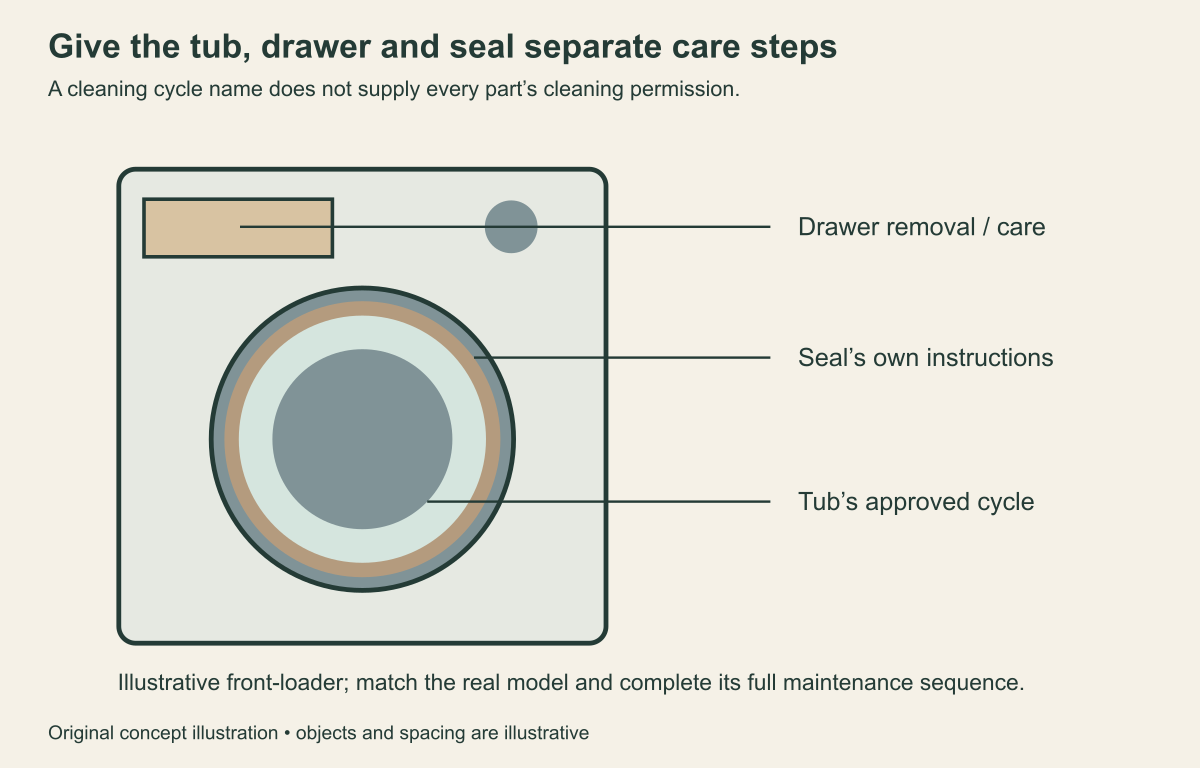
Read the dispenser section separately from the tub-cleaning section and identify the parts the user is allowed to handle. Keep any removal, rinsing and reassembly directions with the exact drawer or insert they describe.
Do not assume that a part is dishwasher-safe because it is plastic or because it comes out. The manual needs to provide the cleaning permission, and a removable shape alone does not answer the material-care question.
For a front-loader, look for the maker’s door-seal care instructions rather than transferring the tub’s chemical method to the seal. A concentrated product intended for one placement may not be an approved hand-cleaning treatment for another component.
Keep ordinary visible soil and an unusual mechanical condition separate in your notes. If you see a damaged part or cannot reassemble an allowed component as directed, stop and contact the maker instead of forcing it into place.
Take a reference photo of a permitted removable assembly before handling it if that helps you follow the manual. The image is a memory aid for the identified parts, not permission to dismantle anything beyond the user-care instructions.
Observe the cycle without inventing a fault
During the selected cycle, use the manual’s expected behavior and any displayed instructions to understand what the machine is doing. A maintenance cycle can behave differently from the normal laundry cycle you know best.
Whirlpool specifically explains that some steam models may not spin or fill during an initial steam phase, and a cleaning tablet may not dissolve completely then. That is a named support-page example, not a claim that every silent or stationary washer is operating normally.
If your machine shows an unexpected message, record it exactly along with the model and selected cycle. A service request with the actual wording is more useful than a guess that the cleaner caused the problem.
Do not open a locked door, bypass a control or remove a panel to investigate the maintenance process. Use the maker’s permitted stopping and service steps if the cycle does not proceed as the instructions describe.
After completion, follow the exact finishing directions before handing the machine back for laundry. A finished timer alone does not establish that every required cleanup or ventilation step has been completed.
Make the reminder useful next time
Keep the cleaning section, permitted product information and last completed date together in the laundry area’s household record. You are documenting what happened, rather than promising that a calendar date guarantees an odor-free machine.
Whirlpool’s inspected front-load page suggests monthly interior cleaning and links detergent amount and type to excessive suds and rinsing concerns. Use those points within the applicable model instructions, rather than creating a universal monthly chemical routine for unrelated machines.
If a problem returns, note when it appeared relative to ordinary loads and maintenance, along with any displayed message. That sequence gives support something concrete to assess without claiming that every smell or residue has the same cause.
Leave a clear maintenance handoff
A useful note for another household member names the washer, its correct manual and the task completed, including any required next step. Avoid a vague statement that the washer was sanitized unless a specific supported process and claim actually establish that.
For an unresolved issue, send the maker the model, cycle, cleaner and observations with no invented diagnosis. The goal is a machine-specific answer and an understandable routine, so the next cleaning reminder starts with known instructions instead of a hurried bottle choice.
Sources and scope
- Whirlpool front-load interior cleaning support
- affresh Washing Machine Cleaner Tablets3Count,W10549845
Sources checked October 14, 2026. This guide uses documented information; it does not claim independent product testing or professional inspection.