Keep the fresh spill from becoming a bigger experiment
A drink tips beside the sofa, and the first impulse is to scrub until the visible mark disappears. Pause long enough to identify the material, keep the area managed, and choose a supported response for the actual carpet or rug.
The Carpet and Rug Institute’s spill guidance distinguishes picking up solids from blotting liquid and advises against scrubbing, which can damage carpet and spread the mess. Its general advice is a starting point, while the installed carpet or rug’s care requirements still govern any product or further treatment.
This article concerns an ordinary, identified household spill on a floor covering with known care information. Hazardous chemicals, bodily-fluid incidents needing special handling, valuable unfamiliar textiles, and unknown materials require their relevant guidance and appropriate help.
Keep a fresh-spill response separate from a promise to remove every stain. A prompt, appropriate first step can preserve a manageable question without guaranteeing the color, fiber, backing, or finish will return to its previous appearance.
Identify what landed and where
Name the spilled material if you know it and note whether it contained more than one ingredient. A plain drink and a drink with milk or other additions create different descriptions for the carpet maker or cleaning professional.

Record whether the affected covering is installed carpet, a removable rug, or a textile layered over another surface. The location matters because the visible area may not be the only part of the arrangement requiring assessment.
Find the floor covering’s product and care information rather than assuming a familiar pattern identifies its fiber. A wool-like appearance or a decorative design is not a washing or chemical-compatibility instruction.
If the textile is valuable, its construction is unfamiliar, or the maker requires specialist care, use the appropriate professional route. A generic household tip should not turn into permission to treat an unidentified rug aggressively.
Keep people and ordinary traffic from enlarging the affected route while you arrange the supported response. The immediate purpose is to keep the area understandable, not to test whether the spill has already stopped transferring.
Separate solids from the liquid task
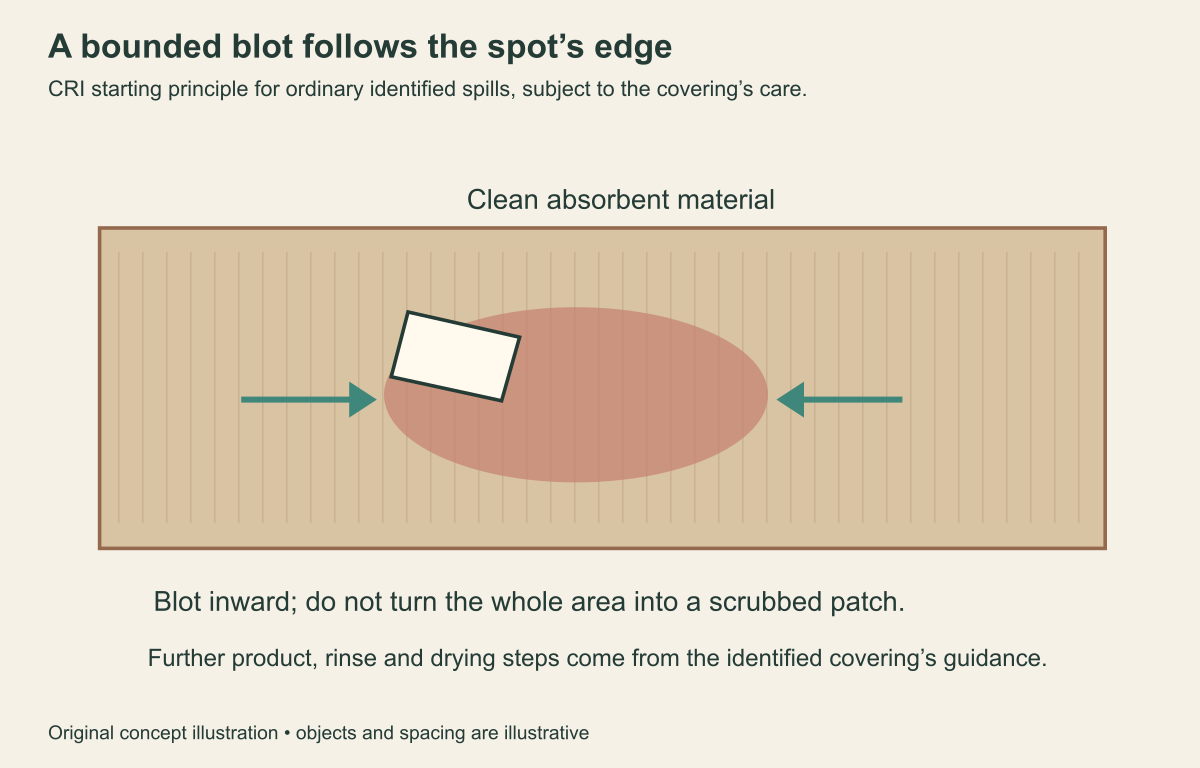
CRI’s guidance says to pick up solids and blot liquid with a dry white cloth or paper towel. It recommends working from the spot’s edge toward its center, with the specific warning not to scrub.
That distinction avoids treating every spill as a wiping task across the whole area. Identify what is actually present before using a method intended for liquid alone on a mixture that includes solid material.
Use the appropriate floor-covering instructions for the ordinary material and tool involved. Do not turn a sharp edge or scraping implement into an improvised way to remove something caught in an unfamiliar pile.
Keep clean absorbent material available for the supported blotting sequence, rather than repeatedly using the same visibly soiled section. The objective is a controlled response to the affected area, not a dramatic scrubbing motion for a photograph.
Do not read a photograph of a cloth beside a rug as proof that the pictured surface has been successfully treated. The actual material and completed procedure must provide that information for your own floor covering.
Choose any cleaning product deliberately
If the care guidance calls for a cleaning solution, confirm the exact product and its compatibility with the carpet or rug. A cleaner approved for a household hard surface does not become appropriate for textile pile simply because it is nearby.
CRI points users toward tested carpet-cleaning solutions in its guidance. That product-selection framework does not replace the covering’s instructions or tell you to apply an unidentified cleaner directly to a fresh spill.
Read preparation, application, any permitted test, rinse, and drying requirements before starting the next treatment. A label instruction at the end of the sequence still belongs to the planned process even if the visible mark changes sooner.
Do not combine several products in an attempt to cover every possible ingredient in the spill. If the first supported response leaves an unresolved mark, retain the product history for the relevant professional instead of making the chemical sequence harder to reconstruct.
Avoid changing concentration or the prescribed method because a patch looks especially dark. The supported conditions remain important when a spot is stubborn, and the appearance alone does not establish which alternative treatment is appropriate.
Make the small-area record useful
Take a wider photograph that shows the spill’s location relative to the sofa, table, or doorway, then a closer view if useful. Keep the light and angle comparable when documenting a later observation so a reflection is not mistaken for a changed mark.
Record the material, approximate time noticed, and the first supported actions performed. Include the actual cleaner and preparation if one was used, leaving uncertain quantities marked as uncertain.
For a rug on another surface, note that arrangement when contacting the maker or a professional. They may need information beyond the visible pile, which a close photograph alone cannot provide.
Do not lift or move a large, wet, or unfamiliar covering without suitable handling guidance. The question about what may be underneath belongs to an appropriate assessment, not a reason to create another problem while investigating the first.
Keep any instruction received specific to the named textile and spill. A procedure for a similar-looking rug should not silently become the care record for every floor covering in the home.
Complete the required drying and access conditions
Follow the relevant covering and product instructions through completion, including any required rinse or drying process. Do not treat the disappearance of the most visible color as permission to omit the remaining steps.
Keep the area managed for the required conditions before restoring ordinary use. A surface that looks less noticeable may still need completion of the instructed process rather than an immediate return of furniture or traffic.
Do not supply an arbitrary universal drying time for a rug, installed carpet, and all possible backing arrangements. Use the actual instructions and obtain appropriate advice when the situation exceeds their scope.
If the textile changes unexpectedly or the affected area appears larger, stop adding treatments and document the observation. That preserves a clearer question for the manufacturer or cleaning professional than a series of unrecorded attempts.
Keep the spill response distinct from ordinary vacuuming with a dry household machine. A machine intended for dry debris should not be used as an improvised liquid-removal device without the relevant equipment’s explicit permission.
Hand a persistent mark to the right person
CRI’s advice recognizes that difficult stains can require professional help. Use that route when the permitted household procedure does not resolve the issue or the textile’s care requirements already call for a specialist.
Provide the covering’s identification, spill ingredients, location, photographs, and every product or process already used. A complete account makes it easier to assess the remaining condition than a request to remove a mystery stain.
Do not describe the mark as a permanent stain or a fully restored surface unless you have the appropriate basis for that conclusion. Record what you can observe and let the relevant assessment address what that observation means.
For the next household incident, keep the actual care information and suitable supplies available before a spill happens. A labeled response kit is useful when it points to the covering’s requirements, rather than promising one universal recipe.
The goal is a prompt, bounded response that respects the textile and leaves a clear next step. Identify the spill, use the supported method, complete its conditions, and let unresolved concerns receive the appropriate expertise.
Sources and scope
Sources checked October 14, 2026. This guide uses documented information; it does not claim independent product testing or professional inspection.