Make the meaning clear before choosing colors
Three cloths beside the sink can look organized while leaving the most important question unanswered: which one has already been used, and where did it go? A household color system is useful when it makes a cloth’s assigned task and current state understandable to the person who picks it up next.
Rubbermaid Commercial describes its HYGEN Sanitizer Safe cloths as color coded by area or task to help reduce cross-contamination. That is a documented product-system purpose, not a universal household rule that gives every blue or red cloth the same meaning.
For a home, choose a small, explicit assignment that fits the actual rooms and the people doing the work. Add readable labels or another clear identifier so the arrangement does not depend entirely on recognizing a shade of fabric.
Imagine two people sharing a kitchen and bathroom, with general furniture surfaces in a third group. The system can distinguish those tasks without pretending that a cloth’s color proves it is clean, compatible with a product, or ready for reuse.
Write the assignments where people can see them
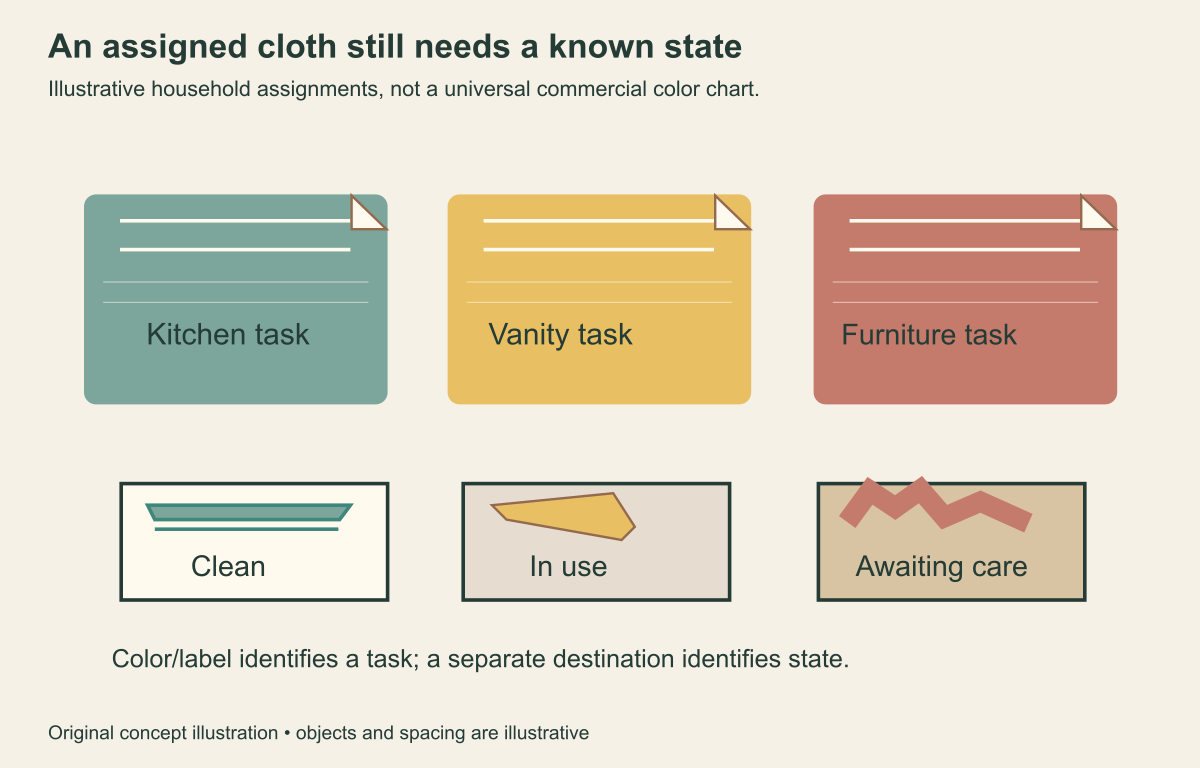
An example household might assign one marked group to kitchen counters, another to bathroom sink and vanity work, and a third to ordinary furniture surfaces. The assignments are examples for organization, not recommendations that every material in each group tolerates the same cleaner or cloth.
Keep toilet-related work clearly distinguished from tools used on other bathroom surfaces. Put that distinction in the label itself rather than assuming the word bathroom communicates the exact earlier use of the cloth.
Choose identifiers that remain understandable when a cloth is folded or placed in its intended storage. If a small colored corner disappears in a tight fold, the label on the compartment may need to carry the assignment more clearly.
Explain the meaning to everybody who might use the supplies. A color chart that only its creator understands cannot provide a reliable handoff when another person cleans the room.
Do not change the assignment casually because a particular cloth happens to be available. If the routine cannot be followed with the supplies on hand, obtain a suitable clean cloth or revise the system explicitly before using it.
Track clean, in-use, and awaiting care separately
Color identifies a planned area or task, but it does not identify the cloth’s current condition. Give clean supplies, cloths currently being used, and cloths awaiting their instructed care separate, clearly labeled destinations.
Picture a blue cloth returned beside two unused blue cloths after wiping a kitchen counter. Without a state distinction, the assignment remains known while the next person still cannot tell which item is ready.
The next useful message is specific: one clean cloth remains in the kitchen compartment, and the used cloth has gone to its care destination. That account gives the household a usable inventory rather than a general impression that supplies are tidy.
Keep enough suitable cloths for the planned sequence of work so the system does not require guessing midway through a task. The needed quantity depends on the actual procedure, surfaces, and cloth instructions, not a universal number chosen for an attractive basket.
Do not treat a folded cloth as permanently clean on every remaining face after it has been used. Follow the appropriate task and product guidance instead of using folding alone to make an unsupported condition claim.
Match the fabric to the surface and product
Rubbermaid’s named Sanitizer Safe HYGEN page describes that specific range as quat and bleach safe. That feature should not be generalized to every microfiber cloth or used to override a cleaning chemical’s instructions for the intended surface.
Read the actual cloth’s care information alongside the surface and cleaning-product guidance. A color match identifies its assigned route, while material compatibility remains a separate check.
For a polished appliance face, consider whether the cloth and its condition match the maker’s permitted method. A cloth previously exposed to debris may be inappropriate even when its household assignment says kitchen.
For a painted cabinet front beside a stone counter, keep both finishes identified. The room label does not create a shared cleaning method for the two materials.
Consider a vanity cloth used first on the basin and then offered for the painted drawer below. Its color describes the general assignment, while the earlier use and the two finishes still require a separate suitability decision before the second task.
If the cloth manufacturer has separate cleaning and sanitizing product guidance, follow the relevant instructions without combining them from memory. The system is meant to reduce confusion, not to simplify away conditions that differ between tasks.
Start with one route instead of a large chart
Try the system during one ordinary, identified cleaning route and observe where the decision becomes unclear. A short kitchen task can reveal whether people can find a suitable clean cloth and return the used item to the right destination.
Notice whether a compartment label names a room too broadly. If the household keeps asking whether the same cloth belongs on the table and the appliance exterior, the assignment may need a clearer task description.
Do not introduce six more colors to solve one ambiguous instruction. A written distinction between food-preparation surfaces and other confirmed tasks may provide more information than another similar shade.
Ask the next person to explain which item they would take and where they would put it afterward. Their answer tests whether the arrangement communicates the intended decision without requiring its creator to stand beside the basket.
Revise the confusing label before expanding the system to another room. An understandable small arrangement is more useful than a complicated chart that people ignore when they are busy.
Treat care as a model-specific procedure
Keep each cloth type’s laundering and drying instructions with its inventory, including any permitted products and temperature conditions. Do not borrow washing instructions from a different microfiber brand because the cloths look similar.
After the specified care, reassess the item’s condition and suitability before returning it to the clean-supply location. A worn cloth, retained debris, or damaged identification may require a different decision from simply folding it into the same compartment.
Keep the household’s task identifiers readable after care. If labels, markings, or colors are no longer distinguishable, resolve that problem before somebody has to guess the cloth’s assignment.
Separate chemical compatibility from color retention when reading care claims. A cloth that stays blue has shown a visible property, not proof that every chosen chemical or laundering method preserves its intended function.
If the needed care instructions are unavailable, ask the manufacturer using the exact product information. Record the answer for that cloth instead of circulating a generic microfiber-washing rule through the household.
Hand off the state, not just the color
A useful end-of-task message names the completed surface, the cloth that was used, and where it now awaits care. It should identify any unresolved surface or product question separately so another person does not inherit an unexplained stopping point.
When visitors or outside help use the supplies, provide the short assignment chart and the clean-versus-used destinations. Do not expect a familiar commercial color convention to match your household’s choices.
If somebody uses a cloth outside its assignment, reassess its condition and appropriate care rather than hiding the mistake in the clean stack. The system only helps when the record of actual use remains honest.
The household chart does not certify a surface as disinfected or a cloth as sterile. It supports clear task separation and inventory, while any specific cleaning or disinfecting procedure still depends on its relevant instructions.
Keep the arrangement small enough to maintain through an ordinary busy week. A clear assignment, a known state, and proper product-specific care make the cloth easier to use responsibly than color alone.
Sources and scope
Sources checked October 14, 2026. This guide uses documented information; it does not claim independent product testing or professional inspection.