Stop repeating the same mop pass
The floor looked clean when you finished, but shoes now seem to catch at the same patch near the kitchen entrance. Repeating the whole cleaning process with a stronger product may change the surface again before you understand what happened the first time.
Treat the sticky feeling as an observation to investigate, not a diagnosis that the floor needs stripping or a harsher cleaner. Start with the floor’s identity, the products used, and a map of where the sensation appears.
This guide uses specific Bona guidance to illustrate product and pad checks, while any actual treatment must fit your identified floor and finish. It does not prescribe a residue-removal recipe for an unknown coating or a chemical mixture for a stubborn patch.
Do not start with a stronger cleaner.
Map the problem before changing it
Note whether the concern covers the whole room, the areas you mopped last, or one isolated spot. A broad pattern and a patch beside the trash can give you different questions to ask, even though neither establishes a cause by itself.

Record when the sensation was first noticed and which normal activity happened afterward. If a liquid was spilled between cleaning and the observation, include that event rather than assuming the mop caused everything that changed.
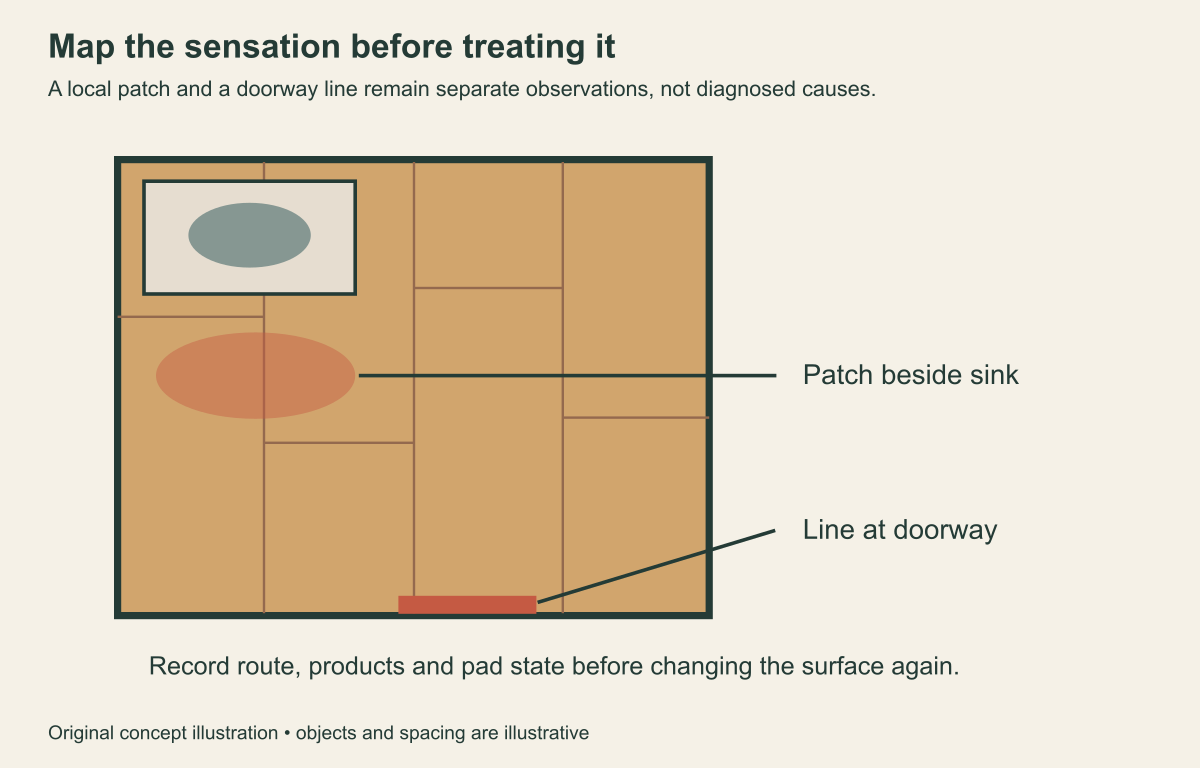
Use a simple sketch of the room with the doorway, work area, and affected patch marked. This lets you compare the observation with the actual cleaning route without relying on a vague description such as the kitchen feels wrong.
For example, mark a patch in front of the sink separately from a narrow line at the doorway. If only the sink patch changes after a supported local treatment, keep the doorway question open rather than writing that the entire room has been resolved.
Do not judge the result while the floor remains wet or introduce unnecessary foot traffic into the work area. Keep the area managed according to the cleaning and floor instructions while assessing the completed result.
If there is lifting, swelling, a changed finish, or another consequential surface problem, stop treating it as ordinary soil. Send the observations to the flooring professional or manufacturer before attempting another cleaning method.
Identify the floor and finish
A plank pattern does not tell you whether the floor is hardwood, laminate, or luxury vinyl. Find the installed product information, invoice, leftover labeled material, or installer’s record before borrowing another floor’s care method.
The finish or treatment can matter as much as the general material. Bona’s FAQ, for example, limits its relevant floor-cleaner guidance to the listed floor types and describes sealed or finished, unwaxed and unoiled conditions.
That is a reason to confirm the actual product’s suitability, not a promise that every Bona bottle or every sealed surface has the same instructions. Match the specific floor and cleaner rather than reasoning from the word hardwood or multisurface alone.
If the home was recently occupied or the floor care history is unknown, ask what products were applied before your cleaning session. A record of previous polish or other treatment gives the professional a specific compatibility question to investigate.
Avoid turning the search for the floor’s identity into an invasive inspection. Ask the installer or property contact for documentation instead of lifting boards or scraping a finish to see what lies underneath.
Reconstruct the product sequence
Place the actual product bottles beside your notes and write their complete names and variants. Include any earlier product applied to the same surface, so the account does not begin only with the bottle used on the last mop pass.
Check whether each product was ready to use or required preparation. Bona says its named hardwood and hard-surface floor cleaners are ready to use and should not be diluted unless the container identifies a concentrate.
That example illustrates why both adding water and adding more cleaner can depart from instructions. It is not a direction to use an undiluted product that you have not identified.
Record the amount and preparation actually used if you know them, leaving unknowns marked as unknown. A guess written as a measured dose makes a later manufacturer discussion less reliable.
Also note any polish, disinfectant, or other product added during the sequence. A product’s own recommended method for removal may differ from the instructions for ordinary floor cleaning.
Inspect the pad and its history
Look at the mop pad’s type, condition, and care instructions, then record where it was used before this room. The word microfiber does not establish the pad’s compatibility with the floor, cleaner, mop attachment, or laundering method.
Bona’s FAQ describes rinsing its cleaning pad during a larger route to release collected dirt, wringing it only slightly damp, and reattaching it. Follow that procedure only within the intended Bona setup and the floor’s compatible care requirements.
For another system, find its actual pad instructions rather than transferring the same process automatically. A disposable pad, a sponge head, and a washable flat pad may have different intended care and replacement arrangements.
Check whether the pad was properly fitted for the task and whether obvious debris or damage remained before use. A pad that was simply taken from the storage basket has not necessarily received its required care since the previous job.
Write that history into the account without claiming it proves the cause. “Pad used in two rooms before this area” is an observation; “the pad caused the sticky floor” is a conclusion you have not established.
Choose the next step from the actual instructions
If the product sequence and floor guidance agree, ask the relevant maker about the observed result before improvising a new mixture. Provide the product names, floor identification, preparation, pad details, and the marked location.
Bona recommends contacting another product’s manufacturer for its removal method because that manufacturer knows the formulation. This is especially useful when your record includes an earlier product that Bona’s ordinary cleaning directions do not address.
Do not treat a general online recommendation to strip, scrub, or neutralize as approval for your finish. The proposed method needs support from the relevant product and floor guidance, not just a description of a similar sticky feeling.
If the manufacturer suggests an assessment or small-area procedure, follow its scope and conditions exactly. Keep a before-and-after record of the same area so a change in appearance is not confused with moving to a different patch.
Leave unresolved cases for appropriate professional assessment when the floor’s identity or prior treatment cannot be established. Stopping before changing the finish again can preserve useful information about the original concern.
Read the result without overclaiming
Compare the same identified area after the instructed process is complete and the required drying conditions are met. Record whether the concern changed, remained localized, or now appears elsewhere.
Do not assume that a different feel proves every earlier product has been removed or the surface has been restored. A useful observation can guide the next question without becoming a chemical measurement or finish inspection.
If the issue returns only after the next routine cleaning, compare that session with the documented one. Look for a changed product, preparation, pad state, or work sequence before enlarging the scope of treatment.
Keep the successful instructions with the floor’s care record so the next person can repeat the permitted routine. Include any product or procedure the maker advised against for the identified floor.
The goal is a supported care method and a clear account of the floor’s response. A stronger smell or more aggressive scrubbing would not provide either of those by itself.
Sources and scope
Sources checked October 14, 2026. This guide uses documented information; it does not claim independent product testing or professional inspection.