Move-out cleaning feels different once the chairs are in a truck and the kitchen drawer you thought was empty still contains three loose utensils. Build the plan around rooms you can finish and inspect, rather than a last-minute promise to clean the whole place after packing.
Start with the actual move-out instructions from your landlord or housing provider and the surfaces’ care requirements. This is a cleaning organizer, not advice about deposit law, lease disputes or a guarantee that a clean room earns a particular refund.
The most useful plan separates belongings, ordinary cleaning and conditions that need someone else’s decision. Each has a different finish line, so one checked box should not hide unfinished work in the others.
Find the actual handoff requirements
Read the instructions you were given for your home, including any stated cleaning, appliance or inspection arrangements. Keep the original wording available while making your own work plan, rather than relying on a friend’s experience in another building.
If an instruction is unclear, ask a specific question with the room or fixture identified. For example, ask whether a supplied appliance needs a named user-care cycle instead of promising to dismantle it or perform an unspecified deep clean.
Separate cleaning tasks from repairs or changes such as wall patching, painting and fixture removal. Those actions need their own authorization and suitable method, and a general moving checklist cannot provide it for your rental.

The American Cleaning Institute’s moving checklist reminds readers to remove trash and personal items, including refrigerator contents and items in cabinets and closets. Use that as a reminder of commonly overlooked spaces, not as proof that its entire checklist matches your agreement.
Keep a short list of open questions beside the confirmed work rather than burying them at the end. You can continue with an ordinary permitted task while a separate repair or appliance instruction waits for clarification.
Give each room three distinct statuses
For each room, track whether your belongings are cleared, its permitted cleaning is complete and its remaining condition has been checked. A room can be ready for cleaning while still needing an answer about a damaged fitting.
Use a visible room name instead of a vague category such as upstairs. The back bedroom and the hall closet can reach different stages, especially when packing boxes move between them throughout the day.
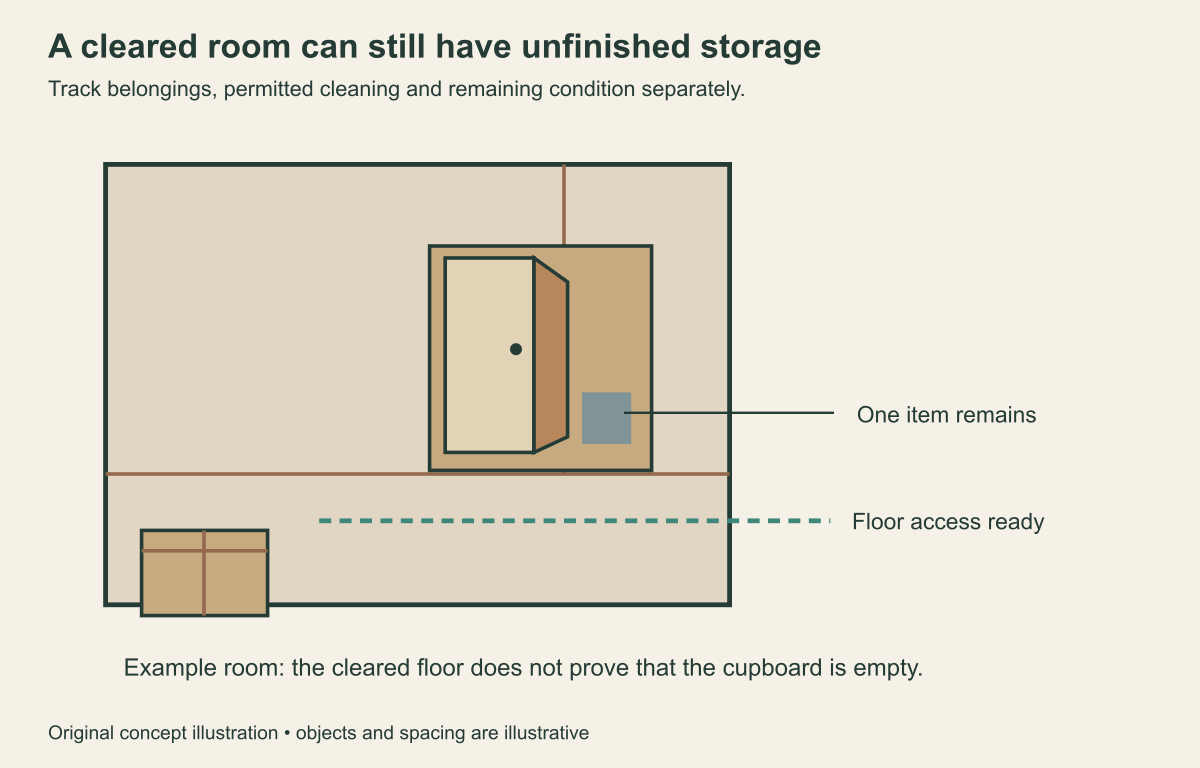
Consider a hypothetical bedroom whose floor is clear but whose wardrobe still holds a suitcase. Mark the floor access ready and the wardrobe belongings unfinished, rather than calling the entire bedroom done.
That distinction helps another person join the work without disturbing a finished area. They can see which cupboard still needs emptying and which surfaces are ready for their approved cleaning method.
Do not use an empty room as evidence that all cleaning is complete. Furniture often concealed edges or storage areas that are only visible after the last item leaves.
Plan packing and cleaning as separate passes
Arrange ordinary belongings removal before the final cleaning of the same area where practical. That avoids repeatedly wiping a shelf that is still being used to hold bags, boxes and packing tape.
Keep the supplies needed for the remaining cleaning available until those tasks are finished, while storing them securely in their original labeled containers. Packing every cloth and compatible cleaner too early can force a hurried substitution near the end.
Create a small set of known supplies for the actual installed surfaces rather than introducing a new all-purpose product for every room. The last day of a move is a poor time to discover that a familiar-looking counter has different care limits.
Decide where packed boxes will wait so they do not cover an area someone is trying to finish. The practical goal is a clear working boundary, not a promise that your home will stay perfectly empty throughout the move.
If you are sharing the work, name the next room and the person handling it before moving supplies around. A simple handoff reduces repeated work when two people assume the same kitchen shelf is still unfinished.
Walk through the kitchen by actual storage space
Open the storage areas you are authorized to use and check each one for your remaining belongings. A broad scan of the kitchen can miss the shallow drawer or high shelf that was rarely part of everyday cooking.
For the refrigerator, separate removal of your food and containers from its permitted cleaning and any appliance handoff instruction. Do not assume that emptying it also authorizes unplugging, moving or changing a supplied appliance’s settings.
Check the care instructions for shelves, drawers and finishes before handling removable-looking parts. A part’s appearance does not establish that it can be removed, washed by a particular method or put in a dishwasher.
Finish one identified storage section with the permitted method and then record its status. That creates a clearer endpoint than moving from cupboard to cupboard whenever another forgotten item appears.
If a shelf or fixture is damaged, describe it separately and follow the property’s reporting arrangement. Cleaning around it should not quietly become an attempted repair that obscures the original condition.
Keep bathroom work within known surface limits
Use the identified fixture and product instructions for the ordinary cleaning that is part of your handoff. A bathroom can contain several finishes, so a cleaner selected for the tub should not automatically spread to a countertop or metal trim.
Plan the contact area and the required finishing steps before beginning a product’s process. If the directions call for rinsing or drying, have the permitted supplies ready so the task is completed before you switch rooms.
Separate a removable everyday residue from a persistent mark or damaged seam in your notes. An unchanged area after appropriate care can be reported honestly without escalating to a stronger chemical during the move’s final hour.
Check the room again once your toiletries, bathmat and storage containers have been removed. Their departure may reveal an overlooked corner, while the products you used should remain securely stored until transport.
Avoid interpreting the inspection as a disinfecting result or a diagnosis of hidden damage. You are recording the condition you can see and the cleaning you actually completed, within the scope of the handoff instructions.
Make a final room check specific
Return to each named room after its ordinary cleaning is complete and compare it with your own three-status record. Look at storage, accessible surfaces and remaining items in turn rather than judging everything from the doorway.
Take useful condition photos in the property’s permitted manner, showing both the room and any unresolved location. A close-up alone may not show which cupboard or wall you mean, and a room overview may hide the small condition you need to report.
Do not describe the photos as proof of legal compliance or a guaranteed deposit outcome. Their value here is a clearer handoff record and a way to show the specific area that still needs a decision.
If a box or bag returns to a finished room, update that room’s belongings status before the final check. The record should describe the current condition rather than preserving a convenient earlier check mark.
Leave the handoff easy to understand
Use the property’s stated method to report remaining conditions and ask about the agreed inspection or key-return arrangement. Give specific locations and actions completed instead of a broad claim that everything has been professionally deep-cleaned.
A useful final note might say that the hall closet is empty and its permitted shelf cleaning is complete, while a loose fitting was separately reported. That tells the next person exactly what the finished cleaning includes and what still belongs to another task.
Once the plan is complete, keep the original instructions and your actual condition record together for your own reference. The aim is an orderly move-out with clear room statuses, so the final walkthrough follows known work instead of forgotten cupboards and hurried guesses.
Sources and scope
Sources checked October 14, 2026. This guide uses documented information; it does not claim independent product testing or professional inspection.